AI Marketing Automation for Roofing Companies: A Practical Lead-to-Estimate System
Learn how roofing companies can connect local discovery, calls, inspections, estimate follow-up, CRM, reviews, and reporting in one governed AI workflow.
- Author: Sarah Chen
- Published: Sep 09, 2026
- Reading time: 24 min
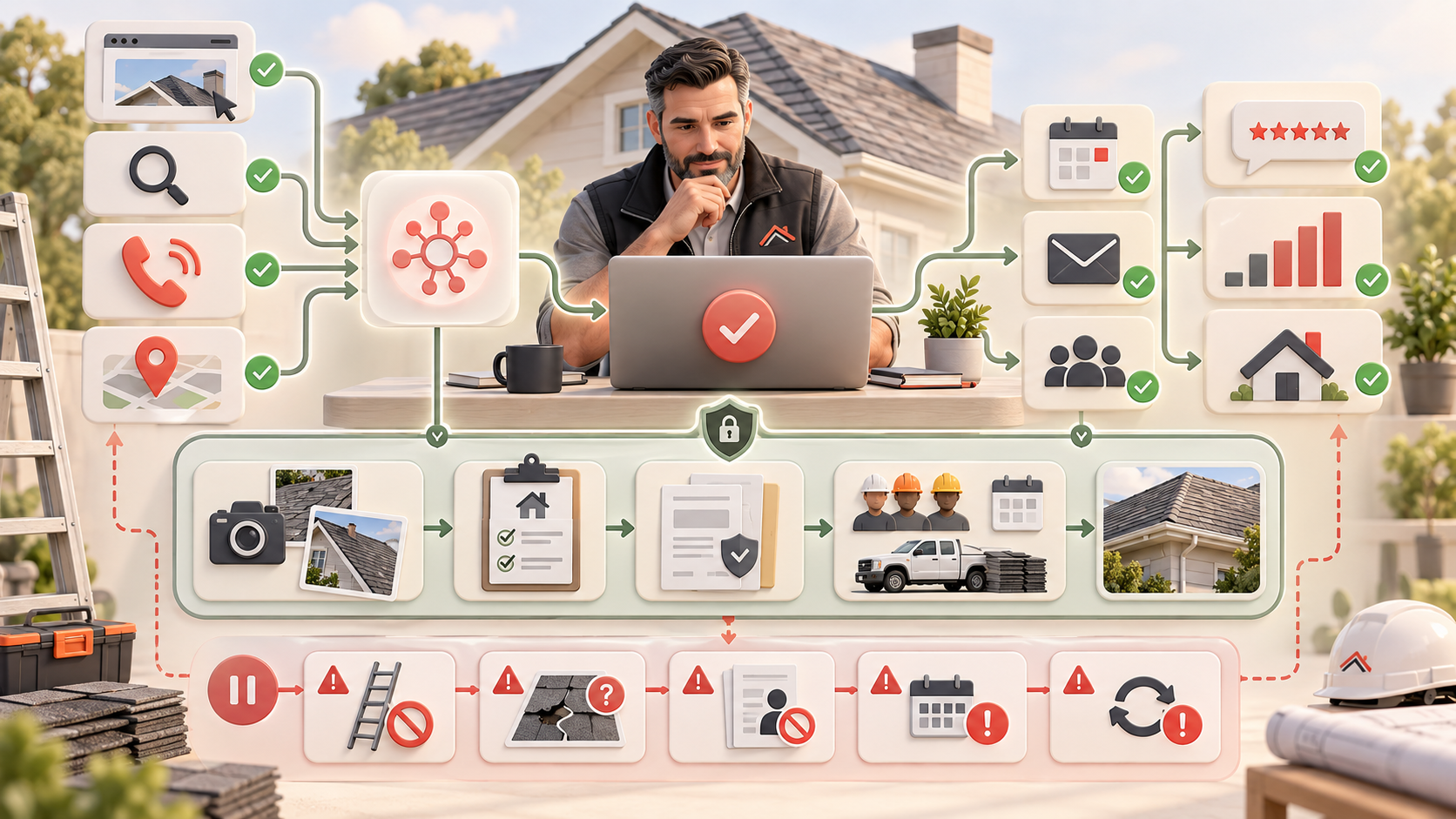
AI marketing automation for roofing companies should help a real homeowner inquiry become a well-managed inspection and an evidence-backed estimate. It should not invent storm damage, promise insurance coverage, quote from an unverified photo, book a crew the production calendar cannot support, or keep contacting someone after consent is withdrawn. A practical system connects local discovery, calls and forms, inspection scheduling, estimate follow-up, CRM, reviews, campaigns, and reporting while roofing professionals own property assessment, scope, price, safety, insurance communication, and the customer relationship.
Roofing has an unusually demanding handoff. Demand can spike after severe weather. One household may contact several contractors through calls, forms, directories, referrals, or lead marketplaces. The office needs to identify the property and permission accurately; the inspector needs the original request and safe access details; the estimator needs verified measurements and evidence; production needs an accepted scope rather than a marketing-stage guess. If those systems disagree, faster follow-up merely accelerates duplicate messages, missed appointments, and promises the company cannot keep.
This guide explains how to design and buy a governed lead-to-estimate system for residential and commercial roofers. It covers useful automation, system boundaries, evaluation questions, measurement, and a staged rollout without fabricated statistics, invented jobs, or guaranteed leads, estimates, rankings, claims, contracts, or revenue.
What is AI marketing automation for roofing companies?
AI marketing automation for roofing companies is a controlled operating layer that combines approved business facts, customer permission, property and opportunity context, workflow rules, connected software, generative AI, and human review. It can normalize an inquiry, summarize a call, draft a first response, prepare an inspection reminder, assemble an estimate follow-up, create local content from approved services, suggest a review reply, or explain a change in pipeline performance. The company remains accountable for the facts, channel permissions, decisions, and actions.
That is broader than an AI receptionist and narrower than autonomous roofing operations. A receptionist may capture a caller and request a time. A governed system must also preserve where the lead came from, avoid duplicates, check the real service area, distinguish emergency mitigation from a normal inspection, synchronize the appointment, stop messages when a person takes over, and record what happened. It should coordinate with the roofing CRM and job-management platform rather than quietly replacing their authoritative records.
The seven records that make roofing automation trustworthy
- **Business truth:** legal business identity, staffed locations, service areas, roof systems, credentials, hours, emergency policy, warranties, financing terms, exclusions, and approved claims.
- **Lead provenance:** source, campaign, vendor, landing page, timestamp, original message, contact details, permission language, and media supplied by the customer.
- **Property context:** address, property type, access notes, known issue, prior relationship, inspection request, and links to evidence without treating a lead form as a diagnosis.
- **Opportunity state:** new, needs review, qualified, inspection requested, scheduled, inspected, estimate in preparation, estimate sent, decision pending, won, lost, or suppressed.
- **Human ownership:** office coordinator, inspector, estimator, sales representative, production handoff owner, and escalation contact.
- **Communication rules:** allowed channels, quiet hours, cadence, templates, response takeover, opt-out, complaint, dispute, and stop conditions.
- **Evidence:** source version, generated draft, reviewer, approval, delivery result, reply, appointment confirmation, inspection record, estimate version, correction, and outcome.
Where the lead-to-estimate journey usually breaks
Roofers often buy marketing software and roofing operations software for different jobs. Search, ads, website forms, call tracking, social, and email produce demand. A CRM manages contacts and opportunities. Calendar tools hold inspections. Measurement, photo, estimating, e-signature, job-management, finance, and insurance-related tools support the work. The customer experiences one company, but the data may cross six systems before an estimate is accepted.
Define the event that moves responsibility at each boundary. A submitted form is not a qualified lead. A requested time is not a confirmed inspection. An uploaded roof photo is not a professional assessment. A draft estimate is not an approved offer. A signed document is not a scheduled installation. Automation should advance a record only when the authoritative system acknowledges the event; otherwise it belongs in a visible exception queue with an owner.
Nine high-value roofing marketing workflows
1. Keep local roofing information accurate
Create one approved source for locations, staffed hours, service areas, residential and commercial services, repair versus replacement capabilities, roof types, emergency policy, credentials, warranty wording, and destination links. Compare it with the website, landing pages, campaigns, directories, and Google Business Profile. AI can flag inconsistencies and draft corrections, but a named operator should approve any public change.
Google's current Business Profile guidelines distinguish storefront, hybrid, and service-area businesses and require profiles to reflect real-world operations. Do not create virtual locations, stuff service areas into business names, or publish pages that imply a crew presence the company does not have.
2. Preserve lead source and permission
Normalize inbound calls, web forms, chat, referrals, directories, canvassing responses, and marketplace leads into one intake structure. Preserve the original submission and the exact source instead of replacing it with an AI summary. If a third party supplied the lead, retain the vendor, timestamp, landing page, disclosure, and permission evidence the business is entitled to use. Unknown permission should produce a review task, not an automated sequence.
Email and text are different channels with different requirements. The FTC's CAN-SPAM compliance guide explains the rules for commercial email, including accurate headers, identification, a postal address, and a working opt-out. The FCC maintains current robocall and robotext guidance. Translate the rules that apply to your locations and tools into consent capture, suppression, revocation, vendor controls, and staff training with qualified advice.
3. Triage without diagnosing the roof
Use simple rules first: served location, service category, property type, business hours, existing customer, open opportunity, and allowed channel. AI can summarize free text and photos, identify missing fields, and ask approved questions such as whether active water entry or a fallen tree is involved. It should not declare damage, interpret policy coverage, advise someone to climb onto a roof, or decide a structure is safe.
Prepare an approved safety route for active leaks near electricity, structural instability, fire, injury, downed utilities, or other hazards. The message should direct the person toward appropriate emergency help and a human roofing contact without improvising technical instructions. Marketing automation is an intake tool, not an emergency-response authority.
4. Schedule inspections from real availability
Offer only appointment windows returned by the authoritative calendar or dispatch system. Capture address, contact, property type, access constraints, preferred communication, and the reason for the visit. Create the appointment with a stable identifier, wait for acknowledgement, then send confirmation. If creation fails, preserve the request and alert a person instead of telling the homeowner the inspection is booked.
Storm surges deserve capacity-aware rules. Queue overflow, narrow geography, prioritize existing service commitments according to published policy, and show the office how many requests remain unconfirmed. Do not manufacture urgency, publish false scarcity, or expand the service area because a campaign produced more inquiries than the team can inspect.
5. Prepare inspectors with concise context
Before the visit, assemble the original inquiry, source, property address, customer-provided photos, prior contact history, access notes, appointment details, and unanswered questions. Keep the source beside the summary. The inspector should record observations and evidence in the operational system; marketing should receive only the status needed to coordinate the next approved communication.
Property photos, measurements, reports, policy documents, signatures, payment details, and job notes should not become general-purpose campaign material. Define field-level permissions, retention, model-use controls, export, deletion, and incident handling. Separate public marketing sources from protected customer and job records by design.
6. Follow up on estimates without crossing the line
Trigger estimate follow-up only after the approved estimate system records that the correct version was delivered. A useful message can confirm receipt, point to the approved document, answer process questions from a controlled source, and provide a direct human contact. It should not rewrite scope, alter price, strengthen a warranty, invent a discount, describe insurance reimbursement as certain, or present financing terms that have changed.
Stop immediately when the customer replies, accepts, declines, requests a revision, raises a complaint, disputes damage or price, withdraws permission, or enters another active workflow. If an estimate changes, retire the old sequence and bind future messages to the new version. The goal is continuity and clarity, not maximum touch count.
7. Build useful local content from verified work
Use approved expertise to answer real buying questions: repair versus replacement process, what an inspection covers, material choices, ventilation, maintenance, commercial roof planning, how scheduling works after a storm, and which documents a customer should expect. The SEO article workflow and website builder can turn a reviewed brief into connected pages without cloning thin location content.
Require rights and context for every project image. Remove addresses, faces, license plates, claim details, and identifying documents unless the company has a documented reason and permission to publish them. Never create a before-and-after story for a job that did not happen or imply that a dramatic outcome is typical without evidence.
8. Request and answer reviews honestly
Use a verified milestone—such as a completed job or resolved service interaction—to request honest feedback neutrally. Do not ask only predicted happy customers, write a review for someone, suppress criticism, or make compensation conditional on positive sentiment. The FTC's current reviews and testimonials rule Q&A gives businesses a useful control reference.
AI may categorize feedback and draft a response, but public replies should not confirm a customer's address, roof condition, insurer, price, payment, schedule, dispute, or warranty history. Route safety allegations, property damage, legal threats, discrimination claims, employee accusations, and unresolved complaints to a private human process.
9. Report from inquiry to accepted estimate
Join campaign, source, inquiry, qualification, inspection request, confirmed appointment, completed inspection, estimate sent, revision, accepted scope, job handoff, completion, and revenue only where stable identifiers reconcile. Label unknown attribution rather than spreading credit across every touch. The analytics and reporting workflow can surface stage conversion and exceptions while managers interpret weather, capacity, geography, source quality, service mix, sales effort, cycle time, margin, and seasonality.
Give AI and roofing professionals different jobs
| Stage
| AI may assist
| A person must own
| Discovery
| Check approved facts, draft pages and campaign variants, flag listing differences, and prepare review.
| Service claims, locations, credentials, offer terms, budgets, creative rights, and publication.
| Intake
| Normalize records, summarize the original request, detect duplicates, identify missing fields, and suggest routing.
| Safety escalation, service fit, customer promises, permission exceptions, and human takeover.
| Inspection
| Prepare context, confirm acknowledged scheduling events, organize customer-supplied evidence, and create tasks.
| Safe access, field assessment, measurements, damage findings, documentation, and recommendations.
| Estimate
| Track approved status, draft version-bound follow-up, detect replies, and stop or escalate the journey.
| Scope, quantities, price, warranty, financing, insurance communication, negotiation, and acceptance.
| Handoff
| Reconcile accepted status, assemble an internal summary, notify owners, and flag missing acknowledgement.
| Contract, deposit, permits, materials, crew, safety plan, schedule, production, change orders, and service recovery.
Enforce that split with permissions, not slogans. A marketing agent should not hold the credentials needed to change an estimate, approve a contract, access every job photo, schedule a crew, or communicate on an insurance claim. The voluntary NIST AI Risk Management Framework provides a practical map, measure, manage, and govern structure for assigning roles, testing controls, monitoring use, and responding to incidents.
What to compare when buying roofing marketing automation software
| Buying question
| Evidence to request
| Warning sign
| Does it fit the roofing stack?
| Demonstrate real call, form, CRM, calendar, photo, measurement, estimate, e-signature, job, email, and reporting handoffs.
| A slide lists integrations, but the vendor cannot show identifiers, acknowledgements, retries, or reconciliation.
| Can it prove permission and provenance?
| Original source, vendor, disclosure, timestamp, channel permission, revocation, suppression, retention, and export.
| All purchased, scraped, canvassed, and inbound contacts enter the same unlimited sequence.
| Can it separate a request from a fact?
| Show how requested, scheduled, inspected, estimated, accepted, and completed states are sourced and corrected.
| A form, photo, AI summary, calendar request, or sent API call is treated as proof of the next stage.
| Are risky claims and actions gated?
| Roles, source citations, review tiers, estimate version binding, field permissions, pause, takeover, rollback, and audit history.
| AI can diagnose damage, promise coverage, change price, publish a claim, or book production without approval.
| Does reporting remain honest?
| Metric dictionary, stable IDs, source-system ownership, cost policy, stage reconciliation, margin context, and unknown attribution.
| Calls, leads, inspections, estimates, signed jobs, and revenue are blended into one guaranteed AI return.
| Can the company test and leave?
| Sandbox, synthetic contacts, volume pricing, model-change notice, full export, deletion proof, credential revocation, and migration path.
| Tests can reach real homeowners, fees hide behind message volume, or suppression and audit history cannot be exported.
A realistic lead-to-estimate workflow
Imagine a residential roofer piloting one repair-and-replacement inquiry path in one verified service area. The approved source contains staffed hours, services, roof types, credentials, emergency language, inspection policy, availability, financing disclosures, warranties, campaign terms, and named owners. Search ads, the website, calls, and referrals all create leads with their original source and permission evidence.
A homeowner submits a form describing a leak and includes two photos. The system preserves the submission, matches the address to an existing customer without merging another household member, and flags a possible electrical-risk phrase. An office coordinator reviews the alert, contacts the homeowner using the approved safety process, and confirms that a normal inspection is appropriate. The calendar returns open windows; the homeowner selects one; the roofing CRM acknowledges the appointment; only then does the system send confirmation.
The inspector receives a concise brief with the original request and records the professional findings in the field system. An estimator prepares and approves the scope and price. When the correct estimate version is delivered, an approved follow-up begins. A customer reply pauses the journey and assigns the representative. Acceptance is read from the authoritative signature system, then reconciled into the CRM. Production receives the accepted scope through a separate controlled handoff. Marketing receives only the status needed to suppress acquisition messages and later request honest feedback.
Measure pipeline quality and control quality together
- **Demand health:** valid calls and forms, source completeness, service-area fit, duplicate rate, spam, permission evidence, and cost by source.
- **Response health:** acknowledgement time, human takeover, unanswered inquiries, channel failures, opt-outs, complaints, and recovery time.
- **Inspection health:** requests, confirmed appointments, completed inspections, cancellations, no-shows, unsafe-access escalations, and schedule exceptions.
- **Estimate health:** preparation time, delivery acknowledgement, revision rate, customer questions, follow-up stops, acceptance, loss reason, and cycle time.
- **Business health:** signed work, service mix, acquisition cost, sales effort, gross margin, production capacity, and attributed revenue where evidence reconciles.
- **Control health:** factual corrections, blocked claims, missing consent, stale availability, failed handoffs, approval time, overrides, and unresolved exceptions.
Never let one headline conversion rate erase the operating story. A source can generate many calls but few serviceable properties. More inspections can overwhelm estimators. Strong estimate acceptance can still produce poor margins or a production backlog. AI is useful when it helps managers see those distinctions and choose a bounded improvement, not when it compresses the company into a flattering score.
A practical 90-day rollout
- **Days 1–15: choose one journey.** Map one service and one area from source to accepted estimate, including owners, permissions, systems, required evidence, stop events, exceptions, and baseline measures.
- **Days 16–30: establish the facts.** Approve services, areas, hours, credentials, inspection language, offers, warranties, financing disclosures, safety messages, availability ownership, and prohibited claims.
- **Days 31–45: clean identity and consent.** Define household and property matching, lead-vendor provenance, allowed channels, revocation, suppression, retention, access, and media boundaries.
- **Days 46–60: connect the minimum path.** Link intake, CRM, calendar, human review, estimate status, approved messages, and a visible exception queue using stable IDs and acknowledgements.
- **Days 61–75: test failure states.** Simulate duplicates, out-of-area leads, active hazards, missing consent, stale availability, failed bookings, estimate revisions, replies, opt-outs, complaints, and broken integrations.
- **Days 76–90: automate one reversible step.** Pilot a narrow action, sample outputs, reconcile daily, measure customer and control outcomes, and expand only after the team can explain and recover from failure.
Frequently asked questions
What is the best AI marketing automation software for roofing companies?
The best fit matches the roofer's service model, geography, lead sources, roofing CRM, scheduling, inspection, measurement, estimating, job-management, email, text, review, reporting, permission, security, and export requirements. Compare products with one real lead-to-estimate journey and its failure cases instead of ranking them by chatbot fluency or feature count.
Can AI qualify roofing leads?
AI can normalize the request, check deterministic service-area and service-type rules, identify missing information, summarize customer-supplied context, and propose a route. A person should own safety escalation, nuanced fit, inspection priority, technical conclusions, scope, insurance-related communication, pricing, and every promise made to the customer.
Can AI follow up on roofing estimates automatically?
Yes, within a tightly controlled workflow. Start only after the approved estimate version is actually delivered. Use verified details, respect channel permissions, make human contact easy, detect replies, and stop for acceptance, decline, revision, dispute, complaint, opt-out, or sales takeover. Do not let the sequence change scope, price, warranty, financing, or coverage language.
Does marketing automation replace a roofing CRM?
Usually no. The roofing CRM or job platform should remain authoritative for customer, property, inspection, estimate, contract, and job states. Marketing automation should coordinate approved discovery and communication around those records, surface exceptions, and reconcile outcomes without creating a competing version of operational truth.
What should a roofing company automate first?
Begin with visibility and reversible work: normalize inquiries, flag missing permission or location data, identify duplicates, create internal response tasks, assemble approved drafts, verify calendar acknowledgements, and stop follow-up when a reply arrives. A narrow estimate-receipt reminder is often easier to govern than a fully autonomous receptionist, quoting agent, or storm campaign.
What is the biggest implementation mistake?
Optimizing for instant contact before defining the authoritative state of the lead, appointment, inspection, estimate, consent, and job handoff. A system can answer quickly and still message the wrong household, book a nonexistent slot, imply a diagnosis, use an outdated estimate, miss an opt-out, or report an unconfirmed appointment as revenue.
Build a roofing growth system around verified handoffs
Best AI CEO connects approved business context, websites, SEO content, campaigns, social workflows, email, analytics, customer records, and operating tasks in one workspace. Use it to coordinate discovery and estimate follow-up while roofing professionals and governed field systems remain responsible for inspections, scope, price, safety, insurance communication, and production.
Explore the Best AI CEO homepage, review the AI operating platform, compare all features, connect opportunities with products and CRM workflows, review workflows for small-business owners and marketing operations teams, compare the broader home-services booking system and B2B lead-generation framework, browse more AI marketing and operations articles, or download Best AI CEO when you are ready to map the workflow.