AI Lead Generation Automation: A Practical B2B Pipeline System
Learn how to connect demand creation, lead capture, qualification, nurture, sales handoff, and reporting in one governed AI lead generation system.
- Author: Sarah Chen
- Published: Jul 24, 2026
- Reading time: 14 min read
AI lead generation automation should help a business create and progress better-fit opportunities, not simply produce a larger contact list. The useful system connects buyer research, demand creation, lead capture, qualification, follow-up, sales handoff, and reporting while keeping people responsible for claims, consent, targeting, and high-value conversations.
That distinction matters for B2B teams evaluating AI lead generation software. A tool that finds names solves a different problem from a platform that builds campaigns. A chatbot solves a different problem from a CRM. Automating one step can save time, but pipeline quality improves only when the steps share a clear ideal customer profile, reliable data, stage definitions, ownership, and feedback.
This guide explains how to design that connected operating system, which workflows to automate first, what should remain under human control, how to run a 30-day pilot, and how to compare point tools with a broader AI growth platform.
What is AI lead generation automation?
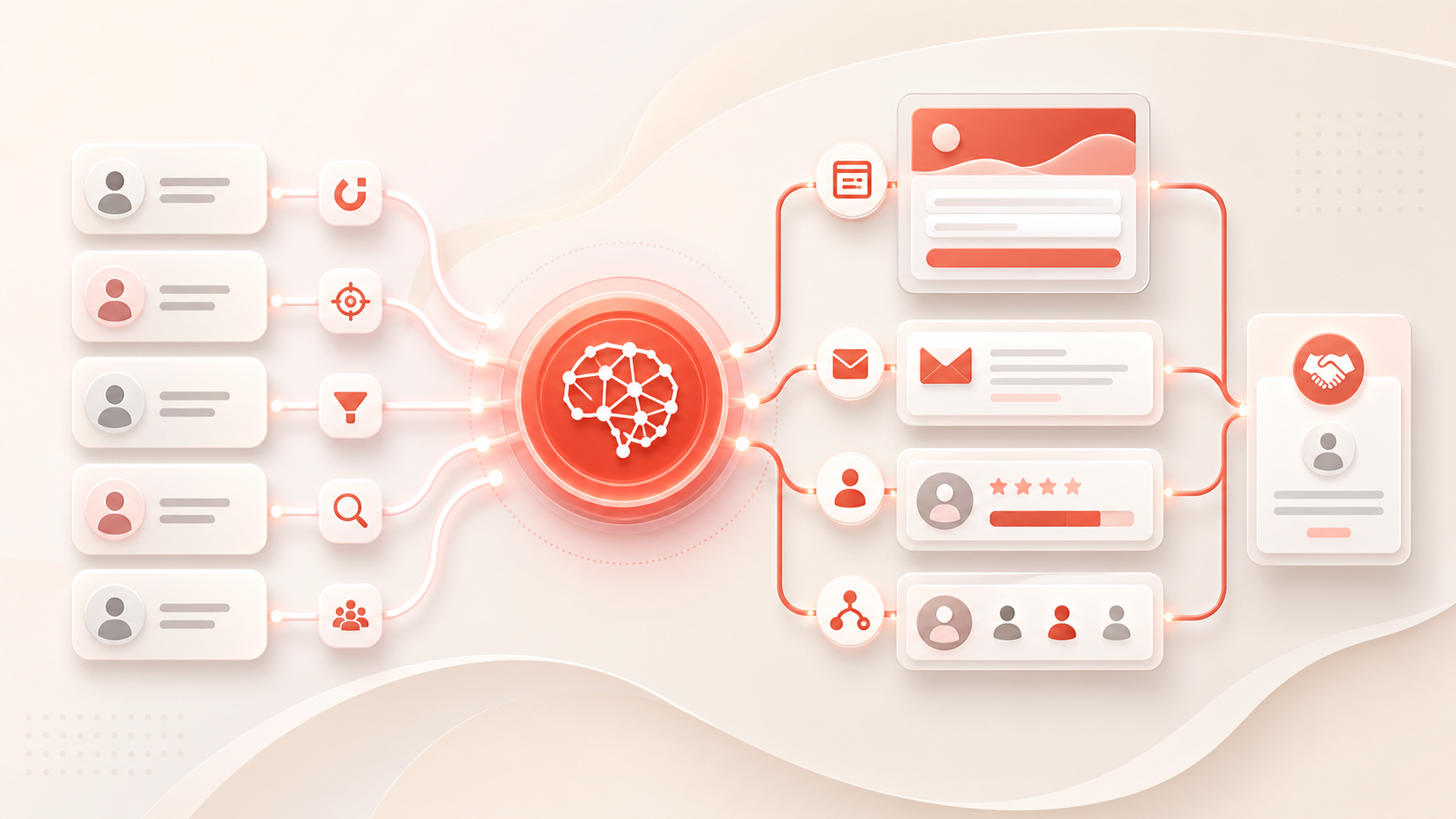
AI lead generation automation combines approved business context, generative AI, workflow rules, customer and campaign data, channel tools, and human review. It can help a team identify useful buyer questions, prepare campaign assets, create focused landing pages, organize lead information, draft relevant follow-up, route qualified inquiries, and summarize pipeline signals.
Traditional automation follows explicit instructions: when a form is submitted, create a contact and notify an owner. AI can interpret less structured inputs around that rule. It can summarize a company description, compare a lead with qualification criteria, draft a reply from approved source material, or explain why an account may deserve review. The trigger, permitted data, approval boundary, and final action still need to be defined.
A complete B2B lead generation system has five layers
- **Market truth:** the ideal customer, urgent problem, offer, proof, objections, exclusions, and buying signals.
- **Demand:** useful search content, social content, email, ads, partnerships, and sales-led outreach.
- **Conversion:** focused pages, forms, calls to action, scheduling, and clear value exchanges.
- **Progression:** qualification, nurture, routing, CRM updates, sales handoff, and suppression rules.
- **Learning:** reporting that connects source and message to lead quality, stage movement, and the next decision.
Best AI CEO is designed to connect those layers. Strategy, brand inputs, SEO, websites, email, social, ads, CRM, analytics, and operating workflows can share one company context instead of forcing a growth team to rebuild the same brief in every tool.
Define a qualified lead before automating volume
A qualified lead is not just a person who opened an email or submitted a form. It is an individual or account that meets agreed fit criteria, has shown a meaningful signal, can be served by the offer, and has a sensible next step. The exact definition depends on the business model, deal size, sales motion, and available evidence.
Write the definition with sales, marketing, and customer-facing teams. Include positive criteria, disqualifiers, acceptable unknowns, evidence sources, stage-entry rules, and the action each stage deserves. If the definition exists only inside a scoring model, teams will debate lead quality after automation has already scaled the disagreement.
Fit signals
- Industry, use case, company profile, or operating model.
- A problem the product can genuinely solve.
- Required geography, language, integration, or service coverage.
- A role involved in using, evaluating, or approving the solution.
- No known exclusion that makes the offer unsuitable.
Intent signals
- A specific problem, project, question, or requested outcome.
- Engagement with pricing, comparison, implementation, or use-case content.
- A reply, demo request, product action, or direct conversation.
- Timing information that supports an appropriate follow-up.
- Repeated behavior that is meaningful for this buying journey.
Use the AI CEO strategy workflow to document the customer, problem, offer, qualification rules, and pipeline goal before choosing automations. This gives every downstream asset and routing decision the same source of truth.
The eight workflows to connect first
1. Turn buyer questions into demand
Start with questions that appear during a real buying decision: how the approach works, who it fits, what it replaces, implementation requirements, risks, integrations, alternatives, and pricing logic. AI can organize those questions into content clusters, campaign briefs, comparison pages, and distribution plans. A subject-matter owner should add product truth, original judgment, and evidence.
Google's guidance on generative AI content supports using AI for research and structure while warning that scaled pages without added value may violate spam policies. Use the AI SEO article workflow to answer a real buyer question and connect it naturally to the next useful page.
2. Build the campaign and conversion page from one brief
A campaign breaks when the ad, post, email, and landing page promise different things. Create one approved brief containing the audience, problem, offer, proof, objections, channel, destination, CTA, tracking plan, and prohibited claims. Generate channel variations and the page from that source, then review them as one journey.
The AI website builder can help create a focused destination for a campaign or search topic. Before launch, test the message match, mobile layout, form fields, privacy language, accessibility, confirmation state, routing, analytics, and every link.
3. Capture enough information for the next action
Ask only for information that changes the next step. An educational download may need less detail than a complex implementation request. Progressive qualification can collect context over time through product behavior, conversations, and voluntary updates rather than placing a long interrogation in front of every visitor.
Record the source, campaign, page, offer, consent state, and timestamp with the inquiry. Keep the person's own words intact. AI can summarize or categorize a message, but the original input should remain available so an owner can verify the interpretation.
4. Enrich and qualify without inventing facts
Enrichment can add useful company or account context when the source and permitted use are clear. AI can normalize fields, summarize public business information, identify missing details, and compare known evidence with qualification rules. It should mark uncertainty instead of filling gaps with plausible-sounding assumptions.
Design the score as an explanation, not a verdict. Show which fit and intent signals contributed, which important fields are unknown, when the record was last updated, and which action the score recommends. Give people a way to correct the record and review high-value or ambiguous leads. The products, entities, and CRM workflow helps keep customer and offer context connected to operating work.
5. Personalize from evidence, not surveillance
Useful personalization explains why the message is relevant. It might reference the use case a person selected, the resource requested, the company information they provided, or an appropriate public business fact. It should not pretend to know private intent, exaggerate familiarity, or use sensitive data simply because a tool can access it.
Create a message hierarchy: verified trigger, relevant problem, approved value, credible proof, low-friction next step, and a clear way to decline. AI can draft variations from those inputs. A person should approve new segments, consequential claims, and communication for strategic accounts.
6. Nurture according to stage and expectation
A pricing inquiry, webinar attendee, newsletter subscriber, referral, and cold account should not enter the same sequence. Define the purpose, permitted channel, frequency, content, owner, stop condition, and human-handoff signal for each journey. Every message should help the recipient make a decision rather than merely keep the sender visible.
The FTC's CAN-SPAM compliance guide explains core requirements for commercial email in the United States, including accurate sender information, a valid postal address, a clear opt-out method, and prompt handling of opt-outs. Other markets have their own rules. The AI email marketing workflow can coordinate approved messages, but the business remains responsible for consent, suppression, deliverability, accuracy, and applicable law.
7. Make the sales handoff complete and timely
When a lead reaches the agreed threshold, give the owner a concise handoff: who the person and account are, what they asked for, which sources were used, which content or product actions matter, what has already been sent, what remains unknown, and the recommended next action. Link the original evidence so sales can verify the summary.
Set service expectations for high-intent inquiries, ownership rules for territories or products, fallback routing when an owner is unavailable, and a visible reason when a lead is returned to nurture. The handoff should prevent the prospect from repeating their story and prevent the team from sending an automated message after a live conversation has begun.
8. Close the loop with pipeline reporting
Lead count alone rewards volume. Connect source, audience, message, page, offer, and follow-up with meaningful outcomes such as qualified conversations, accepted opportunities, stage progression, sales-cycle movement, customer fit, and reasons leads do not advance. Use the measures that match your business rather than copying a generic dashboard.
Ask analytics and reporting to prepare a weekly decision memo: what changed, where quality improved or declined, which explanation has evidence, which data is missing, and which campaign, rule, or handoff should be adjusted next.
Inbound and outbound need different automation rules
Both motions can use AI, but the recipient's expectation is different. Inbound automation responds to an action the person took. Outbound automation initiates contact, so targeting, relevance, data provenance, frequency, and restraint deserve even more scrutiny.
Inbound automation
- Preserve the page, offer, form, and question that created the inquiry.
- Match the response to the action and stated expectation.
- Route urgent or complex requests to a person quickly.
- Do not treat a low-commitment download as sales readiness.
- Stop nurture when a live conversation or disqualifying event occurs.
Outbound automation
- Document why the account fits and where the data came from.
- Use a narrow, defensible reason for contact.
- Keep frequency limits, exclusions, and opt-outs reliable.
- Avoid invented personalization and bulk variations with no real relevance.
- Escalate genuine replies to a person instead of auto-negotiating.
What should stay under human control?
Keep a named person accountable wherever the action affects customer trust, public claims, targeting, spending, permissions, or a consequential sales relationship. AI can prepare the work, but ownership should remain visible.
- **Ideal customer and exclusions:** decide who the business can serve well and who should not be targeted.
- **Claims and proof:** confirm that every promise, comparison, testimonial, and result is accurate and permitted.
- **Data use:** define which sources and fields may be used, for what purpose, and for how long.
- **Scoring and routing:** review criteria for unfair assumptions, weak proxies, hidden uncertainty, and costly false positives.
- **Strategic conversations:** hand nuanced objections, pricing, security, legal, and high-value opportunities to the right person.
- **Learning:** decide whether a pipeline change is causal, coincidental, or too uncertain to act on.
A 30-day AI lead generation automation pilot
Week 1: Map one journey and one definition
Choose a narrow journey such as comparison-page visitor to qualified consultation, campaign landing page to accepted opportunity, or webinar attendee to relevant product conversation. Document the current sources, assets, forms, fields, stages, owners, delays, manual work, opt-out rules, and failure points. Agree on what qualified means and select one business outcome plus two or three operating measures.
Week 2: Build approved context and guardrails
Write the ideal customer, problem, offer, product facts, proof, objections, disqualifiers, stage definitions, permitted data sources, consent rules, messaging boundaries, handoff rules, and prohibited claims. Assign an owner and revision date. Remove fields that do not change a decision.
Week 3: Run a supervised pipeline
Create one demand asset, one focused destination, one qualification path, one follow-up sequence, and one sales handoff from the shared brief. Review every output. Test mobile rendering, forms, tracking, field mapping, duplicate handling, suppression, routing, notifications, and the path for correcting a bad AI interpretation.
Week 4: Review quality before expanding volume
Compare time to launch, response time, revision rate, missing fields, routing errors, opt-outs, accepted leads, useful conversations, and stage movement with the previous process. Read a sample of records and messages rather than relying only on averages. Expand the reliable step; redesign or remove the step that created noise.
How to choose AI lead generation software
Test each platform with the same real journey. A polished demo can hide poor data, disconnected handoffs, weak controls, or maintenance work. Score the operating loop rather than the number of AI features:
- **Job fit:** Does the tool create demand, source data, capture inquiries, qualify, nurture, route, or orchestrate—and is that your actual constraint?
- **Shared context:** Can the ideal customer, offer, proof, brand, stage rules, and exclusions guide every output?
- **Data provenance:** Can you see where important fields came from, when they were updated, and what remains uncertain?
- **Workflow coverage:** Can it connect content, pages, forms, email, ads, CRM, handoffs, and reporting where needed?
- **Human control:** Can people approve consequential work, correct interpretations, pause automation, and take over a conversation?
- **Integration quality:** Does it synchronize reliably with the systems that hold customer, consent, campaign, product, and revenue truth?
- **Governance:** Can the team manage access, retention, suppression, frequency, brand rules, claims, and audit history?
- **Measurement:** Can activity be related to accepted pipeline and customer fit instead of contacts and messages alone?
- **Economics:** Does it remove enough subscriptions, manual coordination, or missed handoffs to justify setup and maintenance?
- **Exit path:** Can you export records and content, replace an integration, and stop the workflow without losing operating history?
A prospecting database may be the right choice when verified contact discovery is the only bottleneck. A dedicated CRM may be right when sales process and opportunity management need the most depth. A connected AI operating system becomes more valuable when the constraint sits between strategy, demand creation, campaigns, follow-up, reporting, and ownership. Compare the categories in the Best AI CEO alternatives guide and the AI marketing operations platform guide.
A simple B2B example
Imagine a consultancy that helps multi-location service companies standardize marketing operations. Its best conversations come from operators who manage several locations, use disconnected channel tools, and cannot explain which campaigns create qualified inquiries. The team approves that profile, its service boundaries, two verifiable examples, disqualifiers, and the questions required before a consultation.
The system prepares a practical search article, a focused assessment page, a short campaign, and follow-up from the same brief. Form responses are summarized but preserved verbatim. Leads with the required fit and a specific operating problem are routed with evidence and unanswered questions. Others receive useful educational content or a polite conclusion. A weekly review connects the source and message with accepted consultations and reasons prospects did not advance.
The value is not guaranteed pipeline. It is a more coherent and reviewable path from a real buyer problem to a useful conversation—and a faster way to improve that path when the evidence changes.
Common questions about AI lead generation automation
Can AI fully automate B2B lead generation?
AI can automate research support, drafting, categorization, summaries, reminders, routing, and reporting around clear rules. People should remain responsible for market selection, data rights, targeting, claims, scoring design, spend, strategic replies, and exceptions. Full autonomy is usually less valuable than a supervised system with fast, explicit handoffs.
Should a small team buy one platform or several specialist tools?
Choose a specialist when one stable step is the clear bottleneck and the team can manage the handoffs. Choose a connected platform when work repeatedly breaks between strategy, content, pages, campaigns, follow-up, CRM, and reporting. Compare total operating effort, not subscription count alone.
What is the best first workflow to automate?
Start with one journey that already has real demand, a clear owner, reviewable inputs, and a measurable next action. For many teams, that is a high-intent page or campaign connected to reliable capture, prompt routing, appropriate follow-up, and a weekly quality review.
Build a connected lead generation system
Best AI CEO connects strategy, brand context, websites, SEO, email, social, ads, CRM, analytics, and operating workflows in one workspace. Start with one qualified journey, keep human approvals visible, and expand only what proves reliable.
See how the platform supports marketing operations and RevOps teams, explore the Best AI CEO platform, review all features, browse more AI growth articles, or download Best AI CEO when you are ready to connect the workflow on your desktop.