AI Marketing Automation for Plumbing Companies: A Practical Lead-to-Booked-Job System
Learn how plumbing companies can connect local discovery, urgent lead intake, booking, CRM and dispatch handoffs, follow-up, reviews, and reporting without automating diagnosis, pricing, or field decisions.
- Author: Sarah Chen
- Published: Oct 07, 2026
- Reading time: 24 min
Plumbing demand rarely arrives in a neat campaign window. A homeowner with no hot water may call after hours, a property manager may request quotes for several sites, and a past customer may need a routine replacement next month. The commercial opportunity is clear: respond quickly, capture the right context, and move each request toward a real next step. The operational risk is just as clear: a fast automated answer can promise an unavailable slot, repeat an expired estimate, or make a technical claim before a qualified person has assessed the job.
AI marketing automation for plumbing companies works best as a governed lead-to-booked-job system. It can coordinate approved website content, local discovery, inquiry intake, routing, booking requests, CRM follow-up, review requests, and measurement. It should not diagnose plumbing problems, set prices, choose parts, dispatch technicians, or confirm work that the field-service system has not accepted.
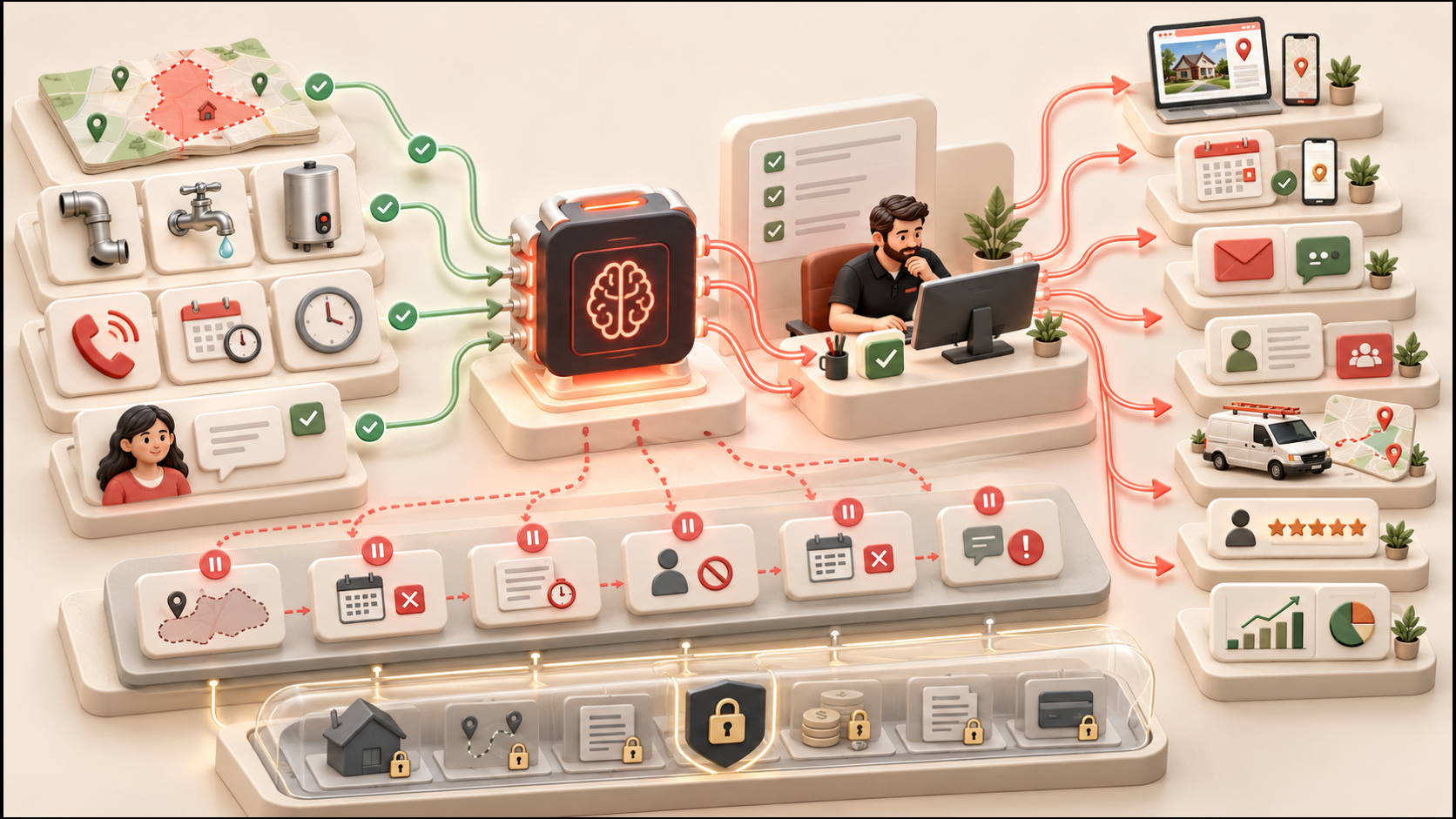
Why plumbing marketing needs an operating system
Most plumbing businesses already have useful pieces: a website, a Business Profile, paid search, call tracking, web forms, email, a CRM, scheduling or field-service software, invoicing, and review tools. The failure usually happens between them. The campaign says emergency service is available, the form accepts the request, the CRM creates a lead, but nobody knows whether the correct branch, skill, part, or appointment window is actually available.
A connected operating system treats every marketing action as part of a controlled state change. A lead is not a booking. A calendar hold is not a dispatched job. A sent estimate is not accepted work. A completed job is not automatically eligible for a review request when a complaint remains open. Those distinctions make automation safer and reporting more useful.
Demand layer
Local pages, ads, calls, forms, chat, email, referrals, and repeat-customer campaigns.
Coordination layer
Identity, consent, qualification, routing, approvals, acknowledged handoffs, exceptions, and measurement.
Operations layer
Technicians, routes, job scope, parts, safety, pricing, contracts, invoices, and payment records.
Build an approved source of truth first
AI should generate from approved facts, not scrape together a plausible answer at the moment a customer asks. Create one owned source pack and assign a person to each field:
- services offered, exclusions, property types, brands supported, and when an on-site assessment is required;
- service areas, branch boundaries, business hours, after-hours policy, and truthful response-window language;
- licenses, insurance, warranties, guarantees, financing language, and the evidence or authority behind each claim;
- booking rules, technician-skill requirements, dispatch ownership, capacity sources, rescheduling, and cancellation policy;
- estimate versions, price authority, expiration, discounts, deposits, terms, and who may approve a change;
- email and messaging consent, suppression, call-recording notices where applicable, review eligibility, image rights, retention, and deletion;
- owners for marketing, customer service, dispatch, technical review, service recovery, privacy, and reporting.
Google explicitly identifies plumbers as service-area businesses and recommends defining coverage with accurate cities, postal codes, or other supported areas. Its service-area guidance is a useful baseline. Use the same approved geography for the Business Profile, location and service pages, campaigns, intake validation, and routing rather than maintaining conflicting lists.
What AI can automate—and what must stay controlled
| Workflow | Useful AI role | Required control
| Local discovery | Draft useful service and location pages from approved facts; flag thin, duplicate, or stale coverage. | A person verifies geography, services, credentials, claims, availability language, and usefulness before publishing.
| Inquiry intake | Normalize forms, email, chat, and call summaries; request the minimum missing property, issue, timing, and contact details. | Do not diagnose the fault, instruct unsafe work, infer private traits, or manufacture urgency.
| Qualification and routing | Suggest branch, service path, account owner, and urgency tier from explicit rules. | Send uncertain, unsafe, out-of-area, commercial, regulated, or high-risk cases to a qualified person.
| Booking | Offer windows returned by the scheduling system and prepare confirmations or reminders. | Confirm only after the authoritative system acknowledges skill, route, duration, capacity, and appointment state.
| Estimate follow-up | Send approved reminders tied to the correct customer, property, version, expiry, and next step. | Never change diagnosis, scope, parts, price, warranty, terms, or availability; pause on reply or revision.
| Maintenance communication | Segment by consented account state, verified service history, equipment context, and current plan. | Check relevance and capacity; keep technical advice within approved educational boundaries.
| Reviews and reporting | Request neutral feedback after eligible completion and connect sources to acknowledged business outcomes. | Do not write reviews, gate sentiment, suppress criticism, contact open complaints, or hide attribution assumptions.
Design a lead-to-booked-job workflow
1. Capture intent without pretending to diagnose
Ask what the customer observes, where the property is, the property type, whether water or a fixture can be safely isolated, preferred timing, and how the team may respond. Use approved safety language for situations such as active flooding, gas odor, sewage exposure, or electrical risk, and route them immediately according to company policy. The intake should not declare the cause or coach a customer through work the business has not reviewed.
2. Resolve identity and duplicates
One person may manage several properties; one property may have a homeowner, tenant, property manager, and payer. Match cautiously using stable identifiers, then show probable duplicates to a person. Silent merges can attach an estimate, access note, complaint, or marketing permission to the wrong record.
3. Route by explicit eligibility
Use approved rules for service area, residential or commercial path, requested service, account status, timing, branch, and technical-review need. A useful automation explains why it selected a path and what information is missing. It also provides a visible exception queue when no rule fits.
4. Book only acknowledged capacity
The marketing layer may display appointment windows supplied by the field-service platform. When the customer selects one, require a successful write and a returned booking identifier before sending a confirmed message. If the write times out or fails, say the request is pending, preserve the attempted window, and alert the dispatcher. A confirmation should never be generated from optimism.
5. Follow up using current state
Bind every message to the latest acknowledged booking, estimate, or job state. Rescheduling retires the previous reminder. A revised estimate ends the old sequence. A customer reply transfers ownership to the responsible person. A cancellation, opt-out, open complaint, or payment dispute suppresses unrelated promotional messaging.
6. Close the loop after verified completion
After the field system confirms completion, the marketing workflow may send approved care information, a neutral feedback request, or a relevant maintenance message. Keep service recovery ahead of review solicitation. Feed qualified inquiry, booking, estimate, completed job, repeat service, and exception states back to reporting so the team can distinguish attention from operational value.
Keep marketing separate from dispatch and field records
Marketing needs enough state to communicate accurately, not a copy of every operational detail. Pass narrow events such as *qualified*, *booking requested*, *booking confirmed*, *estimate sent*, *estimate accepted*, *job completed*, *issue open*, and *maintenance plan active*. Include stable IDs, timestamps, version, source, and owner so each handoff can be reconciled.
Marketing may use
- approved services, areas, hours, and claims;
- consented contact channels and preferences;
- lead source, campaign, and stated intent;
- high-level CRM, booking, and job states;
- approved educational and customer assets;
- feedback eligibility and suppression.
Operations should protect
- keys, gates, alarms, occupants, and access notes;
- technician skills, schedules, routes, and safety records;
- diagnosis, job notes, photos, parts, and technical recommendations;
- pricing logic, discounts, margins, and warranty decisions;
- contracts, disputes, invoices, and payment data;
- private communications and internal performance notes.
How to evaluate plumbing marketing automation software
Do not buy from a chatbot demo alone. Ask each vendor to run one real journey—including the failure states—against the systems your team already uses:
- **Data model:** can it distinguish person, household, company, property, location, issue, appointment, estimate, job, invoice, and maintenance plan?
- **Integration:** are CRM and field-service writes acknowledged, retried, deduplicated, versioned, and reconciled?
- **Availability:** does the booking experience use real capacity and skill rules rather than an independent calendar?
- **Consent:** can it store channel, source, purpose, disclosure, timestamp, preference, opt-out, and suppression?
- **Grounding:** can generation be restricted to approved services, areas, credentials, claims, offers, and educational content?
- **Approval:** can you assign review by channel, claim, service, branch, audience, risk, spend, and novelty?
- **Exceptions:** what happens after a duplicate inquiry, unavailable slot, failed write, revised estimate, open complaint, opt-out, or integration outage?
- **Reporting:** can it connect source to qualified inquiry, confirmed booking, accepted estimate, completed job, repeat work, and exceptions?
- **Portability:** can you export contacts, consent evidence, content, templates, workflow logic, event history, and performance data?
- **Total cost:** what changes with users, branches, contacts, calls, messages, AI usage, integrations, storage, onboarding, and support?
Test an out-of-area request, a tenant without account authority, duplicate calls, a full schedule, an after-hours emergency, a failed booking, two estimate versions, a canceled job, a complaint, an opt-out, and a disconnected integration. Good automation makes the exception visible, preserves context, and stops cleanly.
Responsible messaging, reviews, and AI governance
For commercial email, maintain accurate sender information, truthful subject lines, a valid postal address, a clear opt-out, and timely suppression. The FTC CAN-SPAM business guide explains the baseline requirements. Apply the relevant rules and professional advice for every channel and jurisdiction rather than treating email compliance as permission for texts or calls.
For reviews, ask all eligible customers neutrally and do not condition incentives on positive sentiment. Never ask AI to invent, rewrite, or impersonate a customer experience. Do not suppress criticism or delay service recovery so a score looks better. The FTC reviews and testimonials guidance gives teams a current reference for fake, false, insider, incentivized, and suppressed review practices.
For the AI layer, document intended use, approved inputs, prohibited outputs, owners, decision rights, test cases, monitoring, incident response, rollback, and retirement. The NIST Generative AI Profile is a voluntary risk-management reference. Translate its principles into versioned sources, bounded actions, human approval, logs, sampled quality review, exception queues, and reversible launches.
Measure growth and operating quality together
- **Demand:** valid inquiries, source completeness, service-area fit, service mix, spam, duplicates, consent, and cost.
- **Response:** time to meaningful response, contact success, human takeover, after-hours handling, and abandoned calls or forms.
- **Booking:** booking requests, confirmed appointments, failed writes, reschedules, cancellations, and no-shows.
- **Commercial:** estimates sent, versions, response, acceptance, expiry, decline reasons, and completed jobs.
- **Retention:** repeat work, maintenance-plan state, relevant reminders, opt-outs, complaints, honest feedback, and referrals.
- **Control:** blocked claims, stale facts, wrong-area contacts, duplicate messages, restricted fields, overrides, and unresolved exceptions.
A lower cost per lead is not useful when the leads are outside the service area. More bookings are not a clean win when the calendar write fails or technicians lack the required skill. Faster estimate follow-up is harmful when the message references an old version. Pair every growth metric with a quality, capacity, consent, and exception metric.
A practical 30-day rollout
- **Days 1–5: map one journey.** Choose one branch and service path. Document sources, systems, owners, states, permissions, claims, handoffs, delays, and failure points.
- **Days 6–10: establish approved truth.** Verify services, exclusions, areas, hours, credentials, claims, capacity language, offers, templates, and content owners.
- **Days 11–15: define identity and events.** Specify person, property, account, appointment, estimate, and job IDs plus accepted states, timestamps, versions, retries, and deduplication.
- **Days 16–20: connect the minimum path.** Link intake, qualification, CRM ownership, acknowledged booking, exception handling, and reporting.
- **Days 21–25: test adverse cases.** Simulate missing consent, unsafe requests, duplicate records, full capacity, booking failure, estimate revision, complaint, and opt-out.
- **Days 26–30: launch narrowly.** Start with limited traffic, require human approval, reconcile events daily, compare with a baseline, and expand only after exception rates are acceptable.
Build the workflow before adding volume
Coordinate plumbing growth from one AI operating workspace
Best AI CEO helps teams plan campaigns, create approved content, connect customer context, coordinate follow-up, and review performance in one workspace. Keep diagnosis, dispatch, technician work, pricing, contracts, invoices, and payments in their authoritative systems while AI supports the marketing work around them.
Explore Best AI CEOCompare pricing
Frequently asked questions
What is AI marketing automation for plumbing companies?
It is a governed system that uses AI to assist with approved content, local discovery, inquiry intake, routing, booking handoffs, CRM follow-up, maintenance communication, reviews, and reporting. It is not autonomous diagnosis, pricing, dispatch, repair instruction, or field-service delivery.
What should a plumbing company automate first?
Start with a high-volume, reversible workflow such as inquiry normalization and human-reviewed booking for one branch and service. Measure qualified requests, confirmed writes, manual corrections, opt-outs, and capacity before adding estimate follow-up or maintenance campaigns.
Can an AI chatbot diagnose a plumbing problem?
It can collect what the customer observes, provide approved safety and escalation language, and prepare a summary. A qualified person should diagnose the cause, define the scope, select parts or methods, and approve technical advice.
Does marketing automation replace plumbing CRM or field-service software?
Usually no. CRM and field-service systems remain authoritative for customers, properties, appointments, technicians, routes, estimates, jobs, invoices, and payments. Marketing automation coordinates approved discovery and communication around acknowledged states from those systems.
How should emergency and routine leads differ?
Use separate intake, safety language, response expectations, routing, and follow-up. An urgent request needs fast escalation and capacity confirmation; routine replacement or maintenance may allow education, comparison, and scheduling. Do not use urgency as a marketing tactic when it is not supported by the customer's situation.
Can AI guarantee more booked jobs or revenue?
No. AI can improve consistency, context, and coordination, but outcomes also depend on demand, competition, reputation, response quality, capacity, pricing, field execution, and measurement. Use controlled tests and verified operational outcomes instead of guarantees.
Explore the Best AI CEO homepage, review the AI operating platform, compare all features, connect customer context with products and CRM workflows, review workflows for small-business owners and marketing operations teams, compare the broader home-services booking system, the HVAC lead-to-booking system, and the small-business review system, browse more AI marketing and operations articles, or download Best AI CEO.