AI Marketing Automation for HVAC Companies: A Practical Lead-to-Booking System
Learn how HVAC companies can connect local discovery, calls, booking, CRM and dispatch handoffs, maintenance reminders, reviews, and reporting in one governed AI workflow.
- Author: Sarah Chen
- Published: Sep 17, 2026
- Reading time: 24 min
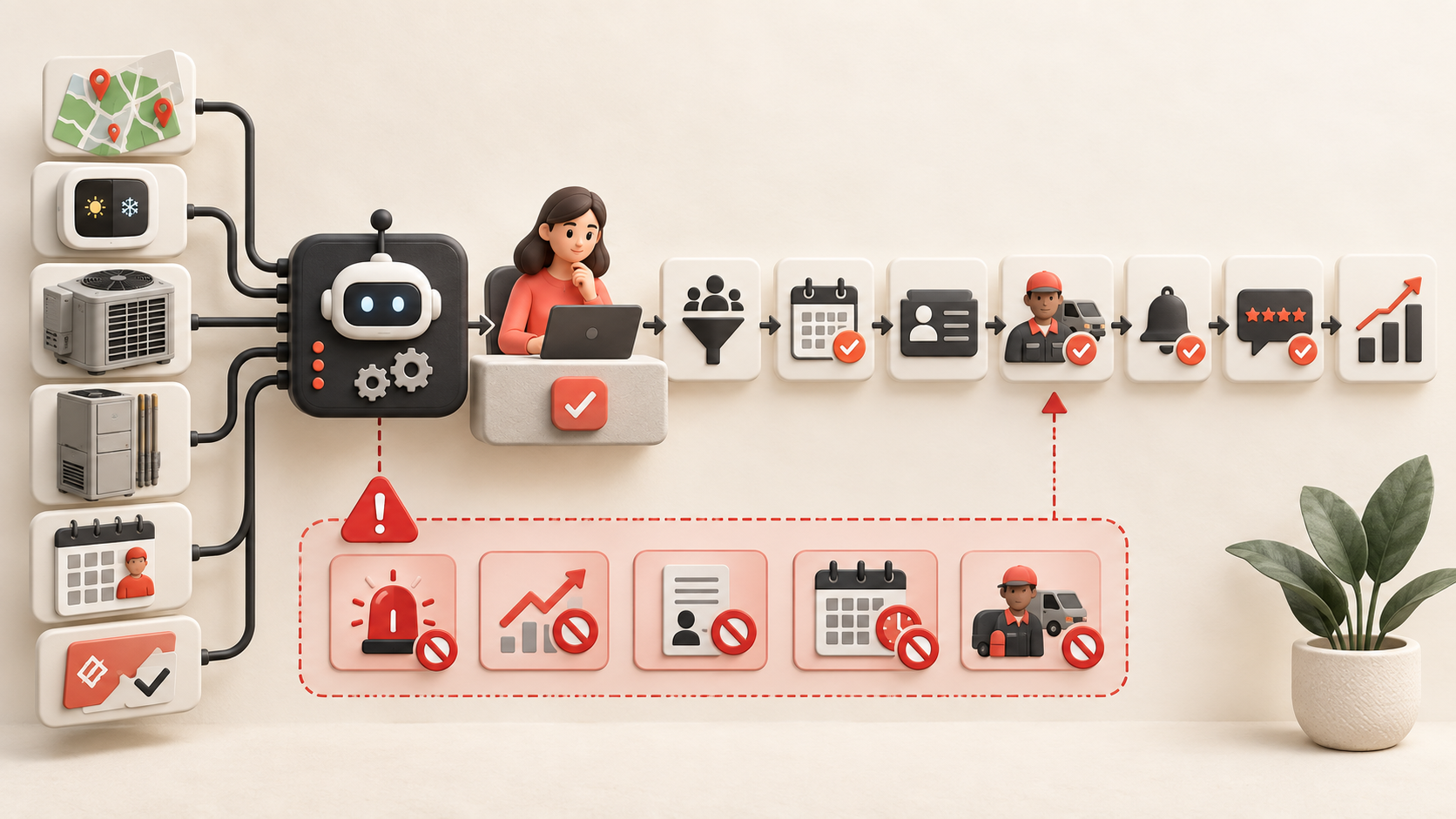
AI marketing automation for HVAC companies should help a real customer request become a correctly routed, confirmed service appointment. It should not diagnose equipment from a message, promise an energy saving, quote an unseen system, invent technician availability, or keep contacting someone after permission is withdrawn. A practical system connects local discovery, calls and forms, booking, CRM and dispatch handoffs, estimate follow-up, maintenance reminders, reviews, campaigns, and reporting while trained HVAC professionals own safety, diagnosis, scope, price, equipment selection, and field service.
Heating and cooling demand is unusually sensitive to weather, equipment failure, geography, seasonality, and crew capacity. A no-cooling call during a heat wave is not the same workflow as a planned tune-up. An existing maintenance customer is not the same record as a new homeowner requesting a replacement estimate. If the website, call platform, CRM, calendar, field-service system, and advertising tools disagree, faster automation can create duplicate bookings, unsafe advice, missed callbacks, and promises the company cannot fulfill.
This guide explains how to design and evaluate a governed lead-to-booking system for residential and light-commercial HVAC businesses. It covers useful automation, source-of-truth boundaries, vendor questions, measurement, and a staged rollout without fabricated statistics, invented savings, fake reviews, or guaranteed appointments, rankings, jobs, memberships, or revenue.
What is AI marketing automation for HVAC companies?
AI marketing automation for HVAC companies is a controlled operating layer that combines approved business facts, customer permission, account and equipment context, workflow rules, connected software, generative AI, and human review. It can normalize an inquiry, summarize a call, identify missing intake fields, draft a response, prepare a seasonal reminder, assemble an estimate follow-up, create service content from approved facts, suggest a review reply, or explain a change in campaign performance. The company remains accountable for every claim, permission, decision, and action.
That is broader than an AI answering service and narrower than autonomous HVAC operations. An answering tool may capture a caller and request a time. A governed system must also preserve the original source, distinguish an emergency signal from a normal request, check the real service area, identify an existing account without merging the wrong household, read availability from the authoritative calendar, wait for the field-service platform to acknowledge the booking, and stop marketing when a person takes over.
The eight records that make HVAC automation dependable
- **Business record:** legal and trading names, real locations, staffed hours, licenses, certifications, services, emergency language, financing disclosures, and named owners.
- **Coverage record:** verified service areas, travel limits, location ownership, excluded zones, after-hours rules, and temporary capacity restrictions.
- **Customer and site record:** contact identity, service address, account relationship, property or facility, communication preferences, and duplicate-resolution history.
- **Permission record:** source, disclosure, channel, purpose, timestamp, opt-out, suppression, retention, and proof that can be exported.
- **Request record:** the customer's original words, reported symptoms, urgency signals, equipment details supplied by the customer, attachments, and unanswered questions.
- **Appointment record:** requested slot, confirmed slot, job type, assigned owner, calendar acknowledgement, dispatch status, change history, and cancellation state.
- **Commercial record:** approved offers, diagnostic-fee language, estimate version, financing terms, membership status, expiration, and evidence supporting marketing claims.
- **Outcome record:** qualified request, booking, completed visit, approved estimate, job, membership event, review request, source cost, revenue where reconciled, and exceptions.
Give each field one authoritative owner. The field-service management platform may own appointments, dispatch, job status, and equipment history. The CRM may own opportunity stage and relationship context. The consent system may own channel permission. Marketing automation should coordinate those records, not quietly create a competing version of them.
Map the lead-to-booking journey before choosing software
A useful requirements document follows one customer journey from source to acknowledged handoff. Map the systems, people, required evidence, stop events, and recovery steps at every stage:
- **Discovery:** a person finds an accurate service page, Business Profile, advertisement, social post, referral, or existing-customer message.
- **Inquiry:** the call, form, chat, or message preserves its source, disclosure, timestamp, customer language, address, and permission.
- **Intake:** the system checks identity, account history, geography, job type, missing fields, and defined emergency or safety signals without pretending to diagnose.
- **Human triage:** trained staff resolve ambiguity, apply the approved safety process, set expectations, and decide whether the request belongs in service, sales, maintenance, or another queue.
- **Booking:** the customer chooses from real eligible slots; the field-service system accepts the appointment; only then does confirmation go out.
- **Dispatch handoff:** operations receive the original request, approved summary, site context, access notes, and permissioned attachments without marketing rewriting technical facts.
- **Follow-up:** acknowledgement, reminders, estimate status, maintenance communication, and review requests begin only from verified events and stop on replies, opt-outs, disputes, or human takeover.
- **Reporting:** stable identifiers reconcile source, request, booking, completed visit, estimate, job, cost, and revenue while unknown attribution stays unknown.
This map exposes the difference between a sent action and a completed event. An API request is not a booked appointment. A calendar hold is not a dispatched technician. A drafted estimate reminder is not customer consent. A campaign response is not revenue. Require acknowledgements and reconciliation at each boundary.
Nine practical HVAC marketing workflows
1. Keep local discovery aligned with real coverage
Build location and service pages from approved combinations of services, systems, property types, hours, credentials, and service areas. Use AI to identify missing pages, inconsistent facts, stale links, duplicate copy, and drafts that need review. A person should approve every claim and every location. Google's Business Profile representation guidelines call for accurate real-world names, addresses or service areas, categories, hours, and eligible locations. Do not create virtual locations or stuff service keywords into the business name.
Connect the approved fact set to the website and landing-page workflow and the SEO and answer-engine workflow. Pause publication when coverage, availability, rebate terms, licensing, or offer ownership is unresolved.
2. Draft seasonal education from approved facts
AI can turn approved service knowledge into maintenance checklists, replacement-planning questions, indoor-comfort explainers, technician-authored notes, email drafts, and social variants. It should cite the source material used, flag unsupported statements, and separate general education from an assessment of one customer's system.
Energy, cost, comfort, air-quality, rebate, and environmental claims deserve a higher review tier. The FTC's small-business advertising guidance explains that objective claims need a reasonable basis and that some energy-efficiency claims depend on standardized evidence. Store the equipment, test, comparison, conditions, date, and qualification behind a claim. Avoid universal savings percentages or language that ignores climate, building condition, installation, usage, rates, and system design.
3. Capture calls and forms without inventing a diagnosis
Preserve the recording or submission where lawful, the customer's original words, source, contact details, service address, preferred timing, system information they supplied, and any safety signal. AI may transcribe, summarize, identify missing fields, check deterministic service-area rules, and suggest the correct queue. It should not convert “the unit is making a noise” into a failed component, give repair instructions, or promise that a technician will arrive before availability is confirmed.
Create an explicit emergency and safety path owned by trained staff. Carbon-monoxide concerns, gas odor, smoke, electrical hazards, vulnerable occupants, extreme-temperature exposure, property damage, and similar signals should trigger the company's approved escalation language and human process. Marketing automation is not an emergency service, diagnostic tool, or substitute for professional judgment.
4. Confirm bookings through the field-service system
Offer only slots that match location, job type, technician skills, service windows, travel rules, and current capacity. Write the appointment to the authoritative system with an idempotency key, wait for acceptance, then send the confirmation. If the write fails or availability changes, keep the request pending and assign a person instead of telling the customer a technician is booked.
Track requested, offered, selected, confirmed, rescheduled, cancelled, dispatched, arrived, completed, and no-access as separate states. That distinction prevents marketing from treating a form submission or unacknowledged calendar request as a completed booking.
5. Follow up on estimates by exact version
Begin estimate follow-up only after the approved document was actually delivered. Reference the correct version and approved expiration, financing, warranty, and scope language. AI may draft a concise acknowledgement, schedule a reminder, summarize a customer's question, or flag silence for a representative. It should not change equipment, quantities, price, warranty, rebate eligibility, financing terms, or technical recommendations.
A reply, revision, acceptance, decline, dispute, complaint, expiration, opt-out, or salesperson takeover should stop the sequence immediately. Read acceptance from the authoritative signature or job platform rather than interpreting a vague message as a contract.
6. Run permission-aware maintenance reminders
Use verified installation, visit, membership, warranty, filter, or approved service intervals to create reminder candidates. Check the current account state, channel permission, suppression, location, and service eligibility before sending. Do not infer equipment condition or create a false sense of urgency from an old note.
Keep operational notices separate from promotional content. The FTC's CAN-SPAM compliance guide explains requirements for commercial email, including accurate routing information, non-deceptive subjects, identification, a postal address, and an effective opt-out. Text and calling rules can depend on consent, content, technology, jurisdiction, and current law; obtain qualified advice for the company's actual program rather than turning a software default into a legal conclusion.
7. Request honest reviews after verified service events
Trigger a review request only after a completed eligible visit, send it to the correct customer, make feedback easy, and route service recovery privately without suppressing criticism. Never fabricate a review, ask AI to impersonate a customer, buy a positive rating, or make an incentive conditional on sentiment. The FTC's Consumer Reviews and Testimonials Rule guidance addresses fake reviews, sentiment-conditioned incentives, undisclosed insider relationships, and review suppression.
8. Create campaigns around capacity, not just demand
A campaign plan should read real service areas, staffing, job types, seasonality, call coverage, approved offers, budgets, and stop conditions. AI can create channel variants through the marketing automation workflow, but managers should approve audiences, claims, creative rights, spend, and launch.
Connect campaign pacing to operational capacity. If response times deteriorate, booking inventory closes, the call queue grows, or an offer expires, pause or narrow the campaign. Generating more leads while dispatch cannot serve them damages trust and makes attribution look better than customer experience.
9. Reconcile marketing with service outcomes
Join source, campaign, inquiry, qualified request, confirmed appointment, completed visit, estimate, approved job, membership, cost, and revenue only where stable identifiers reconcile. Keep cancellations, no-access, duplicate leads, out-of-area requests, warranty calls, and existing-customer work visible. The analytics and reporting workflow can surface changes and exceptions while leaders interpret weather, capacity, service mix, ticket value, close rate, margin, and seasonality.
Give AI and HVAC professionals different jobs
| Stage
| AI may assist
| A person must own
| Discovery
| Check approved facts, find content gaps, draft pages and campaigns, and flag conflicting location data.
| Services, coverage, credentials, technical claims, offer terms, creative rights, budgets, and publication.
| Intake
| Normalize records, preserve the request, detect duplicates, identify missing fields, and suggest routing.
| Safety escalation, urgency, service fit, customer promises, channel permission exceptions, and takeover.
| Booking
| Read eligible slots, prepare a write, wait for acknowledgement, send approved confirmation, and flag failure.
| Capacity policy, skill requirements, emergency handling, overrides, rescheduling, dispatch, and arrival promises.
| Service and estimate
| Assemble context, summarize customer-supplied information, track approved status, and draft version-bound follow-up.
| Diagnosis, safety, load or system assessment, equipment, scope, price, rebates, financing, warranty, and recommendation.
| Retention
| Create reminder candidates, check permission, draft messages, request honest feedback, and surface exceptions.
| Service interval policy, membership terms, complaint recovery, account changes, and sensitive customer situations.
Enforce that split with permissions. A marketing agent should not hold the credentials needed to change an estimate, alter a technician schedule, close a job, modify equipment history, override suppression, or send unreviewed safety instructions. The voluntary NIST AI Risk Management Framework offers a useful govern, map, measure, and manage structure for defining roles, testing controls, monitoring use, and responding to incidents.
What to compare when buying HVAC marketing automation software
| Buying question
| Evidence to request
| Warning sign
| Does it fit the HVAC stack?
| Demonstrate real call, form, CRM, calendar, field-service, dispatch, estimate, payment, membership, email, and reporting handoffs.
| A slide lists integrations, but the vendor cannot show record ownership, identifiers, acknowledgements, retries, or reconciliation.
| Can it preserve truth and provenance?
| Original request, source, customer-supplied facts, approved knowledge, citation, version, reviewer, correction, and audit history.
| A summary becomes a diagnosis, a requested time becomes a booking, or generated copy becomes approved technical advice.
| Can it prove permission?
| Disclosure, purpose, channel, timestamp, source vendor, revocation, suppression, retention, propagation, and export.
| All inbound, purchased, previous-customer, and membership records enter the same unlimited sequence.
| Are risky actions gated?
| Roles, review tiers, field restrictions, booking acknowledgement, claim evidence, pause, takeover, rollback, and incident logs.
| AI can diagnose, quote, promise a saving, alter dispatch, send safety advice, or publish offers without approval.
| Does reporting remain honest?
| Metric dictionary, source-system ownership, stable IDs, cost policy, stage reconciliation, margin context, and unknown attribution.
| Calls, leads, bookings, completed visits, sold jobs, memberships, and revenue are blended into one guaranteed AI return.
| Can the company test and leave?
| Sandbox, synthetic contacts, volume pricing, model-change notice, full export, deletion proof, credential revocation, and migration path.
| Tests can reach real customers, fees hide behind message volume, or consent, suppression, and audit history cannot be exported.
A realistic no-cooling inquiry workflow
Imagine a residential HVAC company piloting one no-cooling request path in one verified service area. Its approved source contains staffed hours, after-hours language, services, locations, licenses, diagnostic-fee wording, memberships, offers, financing disclosures, safety messages, and named owners. The website, paid search, Business Profile, calls, and referrals all create records with their original source and permission evidence.
A homeowner submits a form saying the upstairs system stopped cooling and selects an afternoon preference. The system preserves those words, matches the address to an existing account without merging another household member, reads the known equipment record without treating it as current diagnosis, and checks the service area. No emergency signal is detected, but the customer's preferred slot is unavailable. The system offers two real eligible windows returned by the field-service platform.
The customer selects a window. The platform accepts the appointment and returns its job identifier; only then does the confirmation go out. Dispatch receives the original request, the approved summary, access details, and existing equipment context. A trained technician performs the assessment and records the findings. If an estimate is created, follow-up binds to that exact approved version. A reply stops the sequence and assigns a person. When the visit is completed, the customer becomes eligible for an honest feedback request. Marketing receives only the operational states it needs and never rewrites the technical record.
Measure customer outcomes and control quality together
- **Demand health:** valid calls and forms, source completeness, service-area fit, duplicate rate, spam, channel permission, and cost by source.
- **Response health:** acknowledgement time, human takeover, abandoned calls, unanswered requests, channel failure, opt-outs, complaints, and recovery time.
- **Booking health:** requested slots, eligible offers, confirmed appointments, write failures, reschedules, cancellations, no-access, and dispatch acknowledgement.
- **Commercial health:** completed visits, estimates, estimate revisions, approved jobs, membership events, service mix, cycle time, margin context, and reconciled revenue.
- **Customer health:** repeat contacts, first-time resolution where correctly defined, complaint themes, review-request eligibility, honest feedback, and service recovery.
- **Control health:** factual corrections, blocked claims, missing consent, stale availability, unsafe-language escalations, failed handoffs, overrides, and unresolved exceptions.
Do not let one conversion rate erase the operating story. A campaign can produce many calls but few serviceable addresses. More bookings can overload dispatch. A high sold-job rate can hide weak margins or cancellations. Membership growth can increase future obligations. AI is useful when it helps managers see those distinctions and choose a bounded improvement, not when it compresses the company into a flattering score.
A practical 90-day rollout
- **Days 1–15: choose one journey.** Map one job type and one service area from source to confirmed booking, including owners, systems, required evidence, stop events, exceptions, and baseline measures.
- **Days 16–30: establish approved truth.** Confirm services, areas, hours, credentials, fees, offers, memberships, financing language, safety messages, availability ownership, and prohibited claims.
- **Days 31–45: clean identity and permission.** Define household, address, account, site, and equipment matching plus channel disclosure, revocation, suppression, retention, access, and media handling.
- **Days 46–60: connect the minimum path.** Link intake, CRM, human triage, authoritative availability, booking acknowledgement, approved confirmations, and a visible exception queue using stable IDs.
- **Days 61–75: test failure states.** Simulate duplicates, out-of-area requests, safety phrases, missing consent, stale slots, failed writes, reschedules, technician delays, replies, opt-outs, and broken integrations.
- **Days 76–90: automate one reversible step.** Pilot a narrow action, sample outputs, reconcile daily, measure customer and control outcomes, and expand only after the team can explain and recover from failure.
Frequently asked questions
What is the best AI marketing automation software for HVAC companies?
The best fit matches the company's service model, locations, coverage, call handling, CRM, field-service platform, dispatch, estimates, memberships, email, text, reviews, reporting, permission, security, and export requirements. Compare products with one real lead-to-booking journey and its failure cases instead of ranking them by chatbot fluency or feature count.
Can AI answer HVAC calls and book appointments?
AI can capture the customer's words, collect approved fields, check deterministic service-area rules, identify missing information, propose eligible slots, and prepare a booking write. A person should own safety escalation, nuanced priority, service fit, customer promises, and exceptions. Confirmation should follow acknowledgement from the authoritative field-service system.
Can AI diagnose an HVAC problem from a call or photo?
Marketing automation should not diagnose equipment or give repair instructions from a call, form, chat, photo, or model-generated summary. It can preserve the evidence, organize customer-supplied context, identify an approved safety signal, and route the request. Trained HVAC professionals should own assessment, testing, diagnosis, equipment selection, scope, and safety.
Can HVAC companies automate maintenance reminders?
Yes, when reminders begin from verified account, visit, installation, membership, warranty, or approved interval data and respect current channel permission and suppression. The message should not imply that equipment is unsafe, inefficient, or about to fail unless a qualified person has documented that conclusion.
Does marketing automation replace HVAC CRM or field-service software?
Usually no. The CRM and field-service platform should remain authoritative for customers, sites, appointments, dispatch, equipment, visits, estimates, jobs, and memberships. Marketing automation should coordinate approved discovery and communication around those records, surface exceptions, and reconcile outcomes without creating a second operational truth.
What should an HVAC company automate first?
Begin with visibility and reversible work: normalize inquiries, flag missing permission or address data, detect duplicates, create response tasks, assemble approved drafts, verify booking acknowledgements, and stop follow-up when a person or customer replies. A narrow confirmation or estimate-receipt workflow is easier to govern than a fully autonomous answering, diagnosis, quoting, or dispatch agent.
Build HVAC growth around verified bookings
Best AI CEO connects approved business context, websites, SEO content, campaigns, social workflows, email, analytics, customer records, and operating tasks in one workspace. Use it to coordinate discovery, booking, and lifecycle communication while trained HVAC professionals and governed field-service systems remain responsible for safety, diagnosis, equipment, price, dispatch, and service delivery.
Explore the Best AI CEO homepage, review the AI operating platform, compare all features, connect opportunities with products and CRM workflows, review workflows for small-business owners and marketing operations teams, compare the broader home-services booking system and roofing lead-to-estimate system, browse more AI marketing and operations articles, or download Best AI CEO when you are ready to map the workflow.