AI Sales Automation for Small Business: A Practical Lead-to-Close System
Learn how small businesses can connect lead capture, qualification, follow-up, CRM, proposals, and pipeline reporting in one governed AI sales automation system.
- Author: Sarah Chen
- Published: Aug 01, 2026
- Reading time: 20 min read
AI sales automation for small business should prevent good opportunities from disappearing between an inquiry and a decision. The useful system captures buyer context, organizes the next step, prepares relevant follow-up, keeps the CRM current, and gives an accountable person control over every promise, price, proposal, and customer-facing action.
That is different from buying an AI sales agent and asking it to run the entire pipeline. Small teams often have limited data, informal sales stages, several inboxes, and one person switching between delivery and selling. Automating an unclear process can produce faster confusion: duplicate messages, poor-fit outreach, invented answers, missed opt-outs, or a pipeline nobody trusts.
This guide explains what AI sales automation software should do, which workflows are practical first candidates, what needs human judgment, how to compare platforms, and how to pilot one lead-to-close journey without gambling the customer relationship.
What is AI sales automation for small business?
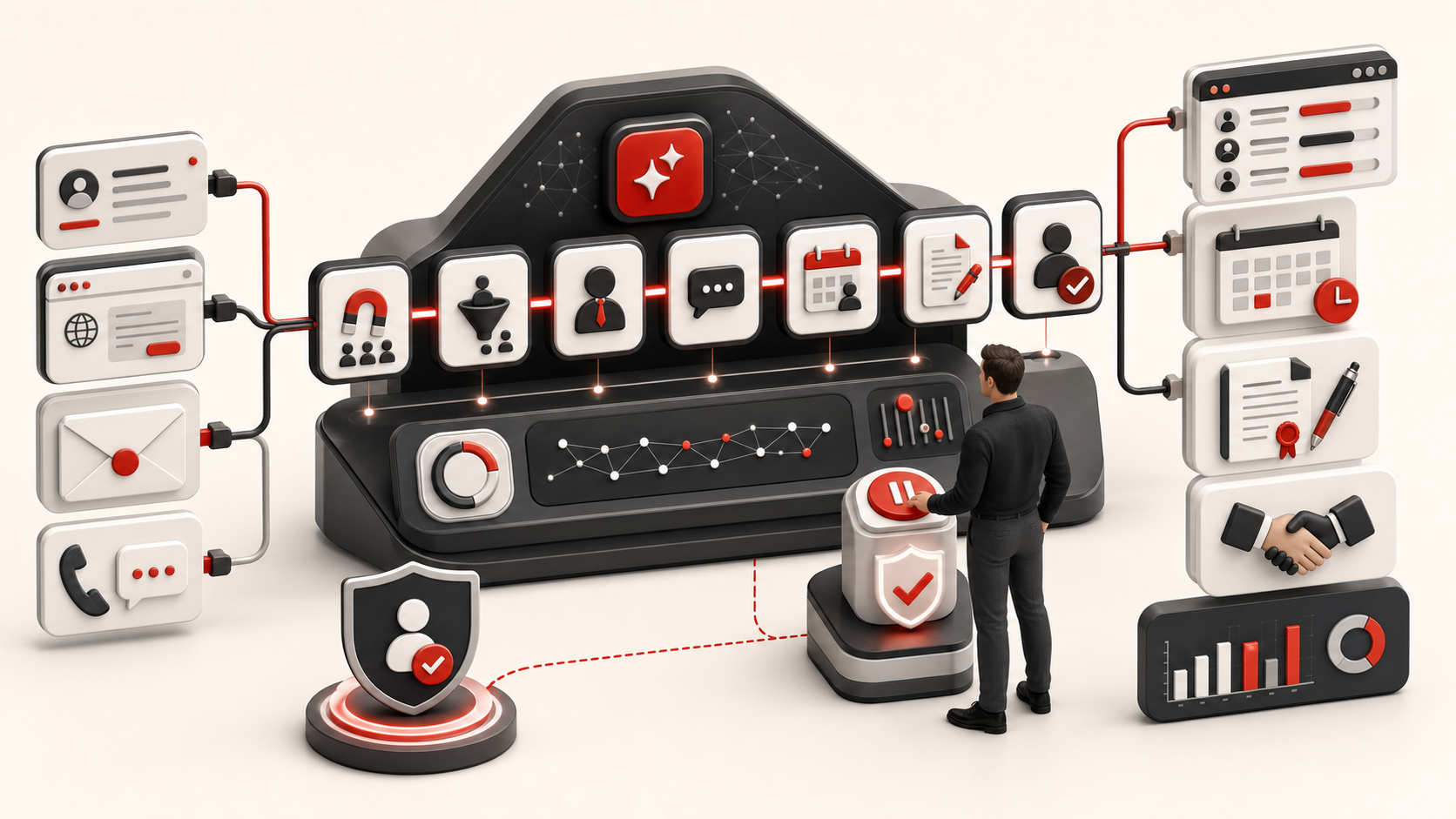
AI sales automation combines a reliable customer record, explicit workflow rules, generative AI, connected communication tools, human review, and performance feedback. It can help a small business summarize inquiries, complete CRM fields, prioritize work, draft replies, prepare meeting notes, identify missing information, create proposal starting points, schedule approved follow-up, and surface stalled opportunities.
Traditional automation handles deterministic steps well: when a qualified website inquiry arrives, create a deal, assign an owner, and set a response task. AI can assist with the unstructured material around that rule: extract the buyer's situation from a message, propose a concise reply, compare the request with the ideal-customer criteria, or summarize a call. The rule should still define the source, owner, permission, review, exception, and next action.
A complete lead-to-close loop
- **Capture:** collect the inquiry, source, consent, customer details, and original message without losing context.
- **Qualify:** compare known facts with explicit fit criteria and flag what still needs a person to learn.
- **Route:** assign an owner, response target, stage, and next task based on clear rules.
- **Engage:** prepare relevant follow-up from approved product, price, policy, and customer context.
- **Advance:** record meetings, questions, objections, decisions, and agreed next steps in the CRM.
- **Propose:** build a reviewable proposal or quote from approved scope and commercial rules.
- **Close and hand off:** confirm the decision, preserve commitments, and transfer accepted context to delivery.
- **Learn:** inspect stage movement, losses, exceptions, data quality, and follow-up outcomes to improve the process.
Best AI CEO is designed to connect strategy, websites, content, email, customer records, analytics, and business operations. A connected workspace matters when a buyer's original need, the marketing promise, the sales conversation, and the delivery commitment would otherwise live in separate tools.
Fix the sales process before adding AI
A model cannot rescue a pipeline with no shared definition of a lead, no owner, and no next step. Begin by mapping one real journey from first inquiry to won, lost, or disqualified. Include the systems people actually use, including spreadsheets and personal inboxes.
- **Entry points:** website forms, chat, referrals, phone calls, events, email, social messages, imports, and partner introductions.
- **Stages:** use a small set with observable entry and exit conditions rather than subjective labels.
- **Ownership:** name the person responsible for each stage, handoff, approval, and exception.
- **Response policy:** define business hours, priority signals, channels, tone, and the manual fallback.
- **Qualification:** separate required facts from model suggestions and from questions that only a conversation can answer.
- **Commercial authority:** document who may approve prices, discounts, scope, terms, claims, and delivery dates.
- **Completion:** decide what makes an opportunity won, lost, disqualified, dormant, or ready for customer onboarding.
Run the mapped process manually for a few representative opportunities. If two people cannot agree on the stage or next action, resolve that ambiguity before automating it. The goal is not a perfect sales methodology. It is a process precise enough that a person can recognize when the workflow is right, wrong, or incomplete.
Create one trustworthy sales source pack
AI-generated sales work needs approved grounding. Build a compact source pack that the business can maintain. Preserve the original materials and give each source an owner and review date.
- **Ideal-customer criteria:** buying situations, good-fit signals, exclusions, service area, capacity, and minimum requirements.
- **Offer facts:** current products, services, capabilities, limitations, availability, pricing rules, and approved bundles.
- **Evidence:** verified results, references, product documentation, testimonial permissions, and qualifications that must accompany a claim.
- **Conversation policy:** tone, required questions, prohibited promises, sensitive topics, escalation triggers, and response boundaries.
- **Commercial rules:** quote inputs, discount authority, payment options, proposal templates, contract path, and expiration rules.
- **Data and contact policy:** permitted sources, consent status, suppression records, field access, retention, deletion, and channels allowed for each contact.
- **Handoff requirements:** the details delivery, onboarding, finance, or customer success needs after a decision.
Do not let a generated summary replace the source of truth. If the source pack says one thing and the CRM says another, the workflow should show the conflict or pause. Quietly choosing the more convenient value creates customer-facing risk.
Eight sales workflows worth automating
1. Lead capture and duplicate control
A supervised workflow can normalize form submissions, preserve the original message, match an existing contact, create or update the correct record, record source and consent, assign an owner, and alert someone when required information is missing. Use stable identifiers and duplicate protection so a retried webhook does not create three deals or three replies.
The website builder can keep the promise, form, destination, and follow-up path connected. Test every form as a customer would, including validation errors, mobile use, after-hours submissions, and the confirmation message.
2. Inquiry summary and data completion
AI can extract an organization, requested service, location, timeframe, stated budget, questions, and suggested next action from an inquiry. Store the original text beside extracted fields and mark uncertain values as unknown. Never turn a model inference into a customer fact merely to complete the CRM.
3. Rule-based qualification with AI assistance
Use explicit criteria for hard requirements such as geography, minimum order, service fit, or required certification. AI can organize supporting context and recommend questions, but an unexplained score should not silently deny service or decide which person deserves a response. Review patterns for missing data and unfair proxies, and provide a path for human correction.
4. Response drafting and follow-up preparation
A good assistant drafts from the buyer's actual question and the approved offer facts. It can propose a concise answer, relevant resource, meeting option, and next step. The owner checks names, claims, links, price, availability, tone, consent, and whether a message should be sent at all. Do not let the model invent urgency, familiarity, discounts, or product capabilities.
Use the email marketing workflow to manage approved templates, sending context, suppression, and reporting. Keep sales follow-up distinct from transactional notices and broader marketing campaigns so the business can apply the correct policy to each message.
5. Meeting preparation and CRM updates
Before a call, AI can summarize the company, inquiry, past messages, open questions, relevant offer details, and previous commitments. Afterward, it can draft notes, proposed field updates, tasks, and a follow-up email. A participant should confirm material facts and commitments before those updates become authoritative or reach the buyer.
6. Proposal and quote assembly
Automation can populate an approved template from accepted CRM fields, scope selections, price tables, tax settings, delivery assumptions, and terms. AI can improve clarity or organize options, but the authorized owner approves the final scope, price, exclusions, timeline, legal language, and recipient. Lock calculation logic outside free-form text generation and preserve the exact sent version.
7. Pipeline hygiene and stalled-deal review
A daily review can flag missing owners, overdue tasks, stages with no supporting event, expired proposals, unanswered buyer questions, and opportunities with no agreed next step. AI may summarize the issue and prepare a recommendation. The sales owner decides whether to follow up, close the opportunity, change the stage, or leave the buyer alone.
8. Won-deal handoff and learning
When a deal is accepted, the workflow can package the signed scope, contacts, billing details, promised dates, risks, preferences, source materials, and first delivery action. The receiving owner confirms the handoff. For lost or disqualified work, capture a short reason without forcing false precision, then review recurring patterns to improve positioning, qualification, and the sales process.
The products, entities, and CRM workspace helps preserve customer, offer, and project context beyond the initial conversation. This is where connected sales automation becomes more useful than a standalone message generator.
Choose autonomy by consequence
Not every sales task needs the same approval. Classify work by the sensitivity of the data, the consequence of an error, and how easily the action can be reversed.
| Sales task
| Possible AI role
| Minimum control
| Internal summary
| Organize approved records and flag missing facts.
| User can inspect sources and correct the summary.
| CRM field suggestion
| Extract a proposed stage, need, or next task.
| Show confidence and original context; review material fields.
| Routine follow-up draft
| Prepare a message from approved facts and history.
| Owner checks recipient, permission, claims, timing, and send action.
| Approved scheduling
| Send a pre-approved message after a defined event.
| Suppression check, duplicate control, log, pause, and failure owner.
| Price, proposal, contract, or sensitive decision
| Assemble context, verify completeness, and prepare options.
| Authorized human approval before commitment or external action.
The voluntary NIST AI Risk Management Framework provides a useful structure for governing, mapping, measuring, and managing AI risk. Its resources emphasize defined human-AI roles, documentation, testing, monitoring, and controls suited to the context. A small business can apply those ideas without a large compliance department by recording sources, permissions, owners, approvals, exceptions, and incidents for each workflow.
Protect consent, contact preferences, and customer data
A contact record is not automatic permission to use every channel forever. Store how the information was obtained, what the person requested, which communications are permitted, and whether an opt-out or do-not-contact instruction exists. Apply suppression before generation and again before sending, because data can change between those steps.
For United States commercial email, the FTC's CAN-SPAM compliance guide explains requirements including accurate sender information and subject lines, a valid postal address, a clear opt-out method, prompt handling of opt-out requests, and responsibility for vendors acting on a business's behalf. Other channels and markets have their own rules. This is operational guidance, not legal advice; use the requirements and professional advice that apply to your business, audience, channel, and location.
- Limit access to the customer fields each role and automation genuinely needs.
- Do not place sensitive personal, payment, health, legal, or confidential data into an unapproved model or prompt.
- Document model providers, connected systems, retention, training use, export, and deletion paths.
- Test unsubscribe, correction, deletion, reassignment, expired access, and manual takeover flows.
- Keep a durable log of the source, version, approver, recipient, channel, time, outcome, and failure.
How to compare AI sales automation software
Shortlist platforms by testing the same real workflow, source pack, buyer example, approval path, and failure case. A polished demo is less informative than watching the system handle incomplete data, a duplicate record, an opt-out, a pricing exception, and a failed connection.
- **CRM fit:** Can the platform use your actual contact, company, deal, activity, product, and custom-field model without flattening it?
- **Grounding:** Can it reliably use current approved offer facts and show the source behind consequential suggestions?
- **Workflow depth:** Do integrations support the exact read and write actions you need, or only generic content generation?
- **Approvals:** Can the system show the recipient, content, source, risk, approver, accepted version, and action before execution?
- **Permissions:** Can access be limited by role, record, field, connection, environment, and action?
- **Reliability:** How does it handle retries, duplicates, partial failures, stale data, expired credentials, conflicting edits, and human takeover?
- **Contact controls:** Are consent, suppression, channel preference, frequency, quiet periods, and unsubscribe state enforced at send time?
- **Explainability:** Can a user distinguish a verified fact, extracted field, model inference, workflow rule, and human decision?
- **Measurement:** Can reports preserve stage definitions, source history, data gaps, corrections, and comparable periods?
- **Economics:** Include seats, contacts, enrichment, model usage, email or calling charges, premium integrations, implementation, review time, and failed runs.
- **Security and exit:** Review authentication, encryption, audit logs, subprocessors, retention, export, deletion, incident handling, and how you leave.
A CRM-centered suite can be right when pipeline records and sales communications dominate. A specialist engagement tool can suit a defined outbound motion. A general workflow builder may fit a technical operator with stable systems. A connected AI operating system becomes more valuable when customer context must travel across website, content, email, sales, proposals, reporting, and delivery. Compare the broader categories in the Best AI CEO alternatives guide and the AI marketing operations platform guide.
Measure workflow quality, not message volume
More automated touches can make a dashboard busy while making the buying experience worse. Use measures that reveal whether the process is reliable and useful.
- **Coverage:** inquiries with a valid owner, stage, source, consent state, and next action.
- **Timeliness:** time to a meaningful response during the business's stated service window.
- **Data quality:** corrected fields, duplicate records, missing sources, and unsupported inferences.
- **Workflow reliability:** completed, failed, retried, duplicated, paused, and manually recovered runs.
- **Review quality:** approval time, correction rate, claim errors, wrong-recipient risks, and pricing changes caught before send.
- **Buyer progress:** agreed next steps, completed meetings, accepted proposals, clear losses, and stalled opportunities by defined stage.
- **Customer signals:** replies, objections, opt-outs, complaints, confusion, and handoff issues.
- **Business outcomes:** qualified pipeline, won work, sales-cycle movement, delivery fit, retention context, and operating cost—without pretending automation alone caused them.
Use analytics and reporting to connect activity with the broader plan. Preserve definitions and note changes in tracking. A model-generated forecast or attribution estimate is an input to judgment, not certainty.
A 30-day small-business sales automation pilot
Week 1: Map one inbound journey
Choose one lead source and one offer with enough recent examples to understand normal variation. Map the path from inquiry to accepted next step, won, lost, or disqualified. Record a modest baseline for ownership, response time, missing fields, follow-up completion, stage accuracy, corrections, and handoff issues.
Week 2: Build the source pack and controls
Approve the qualification criteria, offer facts, response boundaries, consent rules, suppression logic, CRM fields, stages, owners, escalation triggers, and manual path. Connect a test environment or sample records first. Confirm that the workflow cannot send, quote, or change a consequential field without the intended approval.
Week 3: Run in recommendation mode
Let AI summarize, propose fields, draft replies, prepare tasks, and identify stalled work without sending or committing changes automatically. Test ordinary examples plus an existing customer, a duplicate, an incomplete inquiry, an unsupported request, an opt-out, a pricing exception, a hostile message, and a failed integration.
Week 4: Add one controlled action
Allow one low-risk, reversible step after explicit approval, such as creating a CRM task or scheduling an already accepted follow-up. Review data corrections, response quality, missed context, workflow failures, manual recovery, customer signals, team effort, and software cost. Expand the reliable stage rather than the number of autonomous actions.
A practical example
Imagine a six-person commercial cleaning company that receives requests through its website, referrals, and email. The team serves a defined area, prices work after learning the site size and service requirements, and needs an operations manager to approve unusual schedules or scope.
For website inquiries, the workflow preserves the original request, checks for an existing customer, records source and contact preference, creates a deal, and assigns an owner. AI extracts the location, property type, requested frequency, timeframe, and unanswered questions, marking uncertain fields as unknown. It drafts a helpful acknowledgment using the approved service facts. The owner reviews and sends it.
After the discovery call, AI prepares notes and a proposed next-step email. The owner confirms the site details and commitments. A rule-based quote template calculates the permitted options; the manager approves the final price and schedule. If the buyer accepts, the exact scope and promised start date move into the operations handoff. If the opportunity stalls, a review shows the last agreed action instead of launching an endless generic sequence.
The system does not guarantee more sales. It creates a visible, reviewable route from inquiry to customer decision and delivery, with fewer opportunities for context to disappear.
Common questions about AI sales automation
Can AI automate the entire sales process?
AI can assist with repeatable capture, organization, drafting, checking, routing, scheduling, and reporting. Customer discovery, sensitive questions, novel objections, consequential qualification, promises, pricing, proposals, contracts, and unusual exceptions need accountable human judgment. The right boundary depends on the offer, customer, channel, data, regulation, and reversibility of the action.
Do I need a CRM before using AI sales automation?
You need a trustworthy system of record, though it can begin simply. If customer history, stage, owner, consent, and next action exist only in individual inboxes, AI will work from fragmented context. Choose a data model the team will actually maintain before adding complex automation.
What should a small business automate first?
Start with a frequent inbound workflow where the source is known, the owner is clear, the reply uses approved facts, and a mistake can be stopped or corrected easily. Inquiry capture, duplicate checking, internal summaries, task creation, meeting preparation, and draft follow-up are usually safer than autonomous prospecting or pricing.
How is AI sales automation different from marketing automation?
Marketing automation generally manages audiences, campaigns, nurture, and engagement before or around a sales conversation. Sales automation manages named opportunities, qualification, ownership, follow-up, meetings, proposals, pipeline state, and handoff. They should share approved customer and offer context while preserving distinct permissions, consent rules, measures, and owners. See the AI lead generation automation guide for the wider demand-to-handoff system.
Build a governed lead-to-close system
Best AI CEO connects customer context, websites, email, CRM, analytics, proposals, and operating workflows in one workspace. Start with one real inquiry path, keep human approval visible, and expand from evidence.
Explore the Best AI CEO platform, review all features, see the workflow for growth leaders, browse more AI business articles, or download Best AI CEO when you are ready to connect your sales process.