AI Marketing Automation for Restaurants: A Practical Guest Growth System
Learn how restaurants can connect accurate menus, local discovery, reservations, guest messaging, reviews, campaigns, and reporting in one governed AI workflow.
- Author: Sarah Chen
- Published: Aug 06, 2026
- Reading time: 19 min read
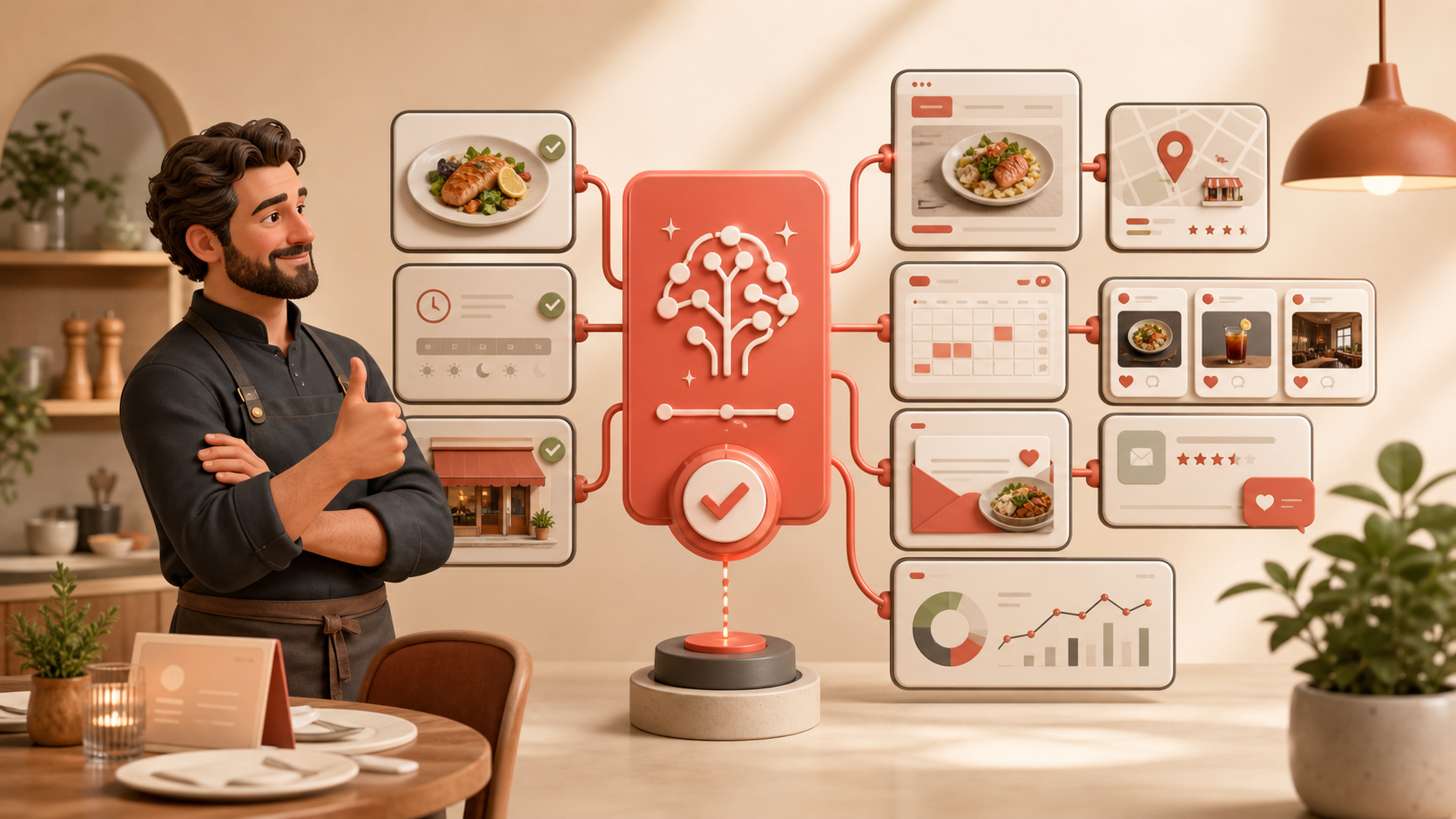
AI marketing automation for restaurants should turn accurate operating information and permission-aware guest data into timely, useful marketing. It should not invent menu items, publish the wrong hours, manufacture reviews, or send a dinner offer to every address in the database. The practical system connects menu and location truth, local discovery, reservations, ordering, guest communication, content production, review handling, and performance reporting while keeping a named operator responsible for what reaches the public.
That operating discipline matters in restaurants because marketing changes at service speed. An item sells out, weather changes patio plans, a private event affects hours, a reservation book fills, or a new menu launches. When the website, map listing, social calendar, email platform, ordering links, and front-of-house team work from different information, even polished campaigns can create disappointed guests and extra work.
This guide explains how to design a connected restaurant marketing system, which workflows to automate first, how to evaluate software, what humans should approve, and how to run a bounded pilot without promising guaranteed bookings, orders, foot traffic, or revenue.
What is AI marketing automation for restaurants?
AI marketing automation for restaurants is a coordinated workflow that uses approved restaurant data, explicit rules, generative AI, connected tools, and human review to execute repeatable marketing work. It may help prepare a menu-launch campaign, segment an opted-in guest list, draft channel-specific content, suggest a reply to a review, schedule an approved offer, or summarize results. AI assists with retrieval, drafting, organization, and pattern finding; the restaurant remains accountable for facts, permissions, claims, prices, availability, brand voice, and final actions.
A simple scheduler publishes content at a chosen time. A governed operating system checks whether the source information is current, selects the right approved template, recognizes location and audience boundaries, routes sensitive content for review, records the destination response, and stops when an item, offer, consent state, or operating condition changes. The advantage is not more posts. It is fewer broken handoffs between the guest promise and the actual experience.
A complete restaurant marketing system connects six layers
- **Source truth:** locations, hours, service modes, menus, prices, availability, ordering and booking links, brand guidance, and approved claims.
- **Guest context:** original source, stated preferences, visit or order history where lawfully held, consent, suppression state, and active service conversations.
- **Decision rules:** location scope, eligibility, timing, frequency, approvals, capacity limits, escalation, and stop conditions.
- **Creation:** website updates, local posts, emails, social content, ads, event pages, loyalty messages, and reply drafts grounded in approved inputs.
- **Execution:** scheduling, publishing, list updates, booking and ordering links, internal tasks, retries, and exception queues.
- **Learning:** delivery, engagement, bookings, orders, redemptions, guest feedback, corrections, and operational failures using clearly defined measures.
Best AI CEO is built around this connected operating model. A restaurant team can carry the same verified brand, audience, offer, and campaign context into websites, email, social publishing, advertising, analytics, customer records, and the tasks that keep every channel aligned.
Start with restaurant truth, not generated copy
Before automating a campaign, define the authoritative owner for every volatile fact. The point-of-sale or menu system may own current items and prices. The reservation platform may own table availability. A location manager may own special hours and service interruptions. The website or customer platform may own consent and suppression records. AI should retrieve these facts or request confirmation; it should never fill gaps with plausible language.
Create a compact source pack for each location: exact business name, address, phone number, regular and special hours, service modes, menu and ordering URLs, reservation URL, accessibility and dietary statements that have been verified, approved photography, brand voice, claims requiring review, offer terms, escalation contacts, and the timestamp and owner of each record. Multi-location groups also need explicit inheritance rules so a brand-level campaign cannot overwrite a local exception.
This approach improves guest experience and search consistency at the same time. Google's current restaurant Business Profile guidance connects core information, menus, ordering, bookings, photos, posts, review replies, and performance metrics. Treat those elements as operational records, not isolated marketing fields.
Eight restaurant marketing workflows worth automating
1. Keep location information and campaign destinations aligned
Monitor the records that guests rely on: hours, menu links, booking links, ordering providers, phone numbers, service options, and event details. When an authoritative value changes, create a checklist for every affected destination. Do not let automation silently edit high-impact fields everywhere on its first day. Start by detecting mismatches, showing the source and destination side by side, and asking the responsible manager to approve the correction.
2. Turn one approved brief into channel-ready drafts
Build a brief around a real occasion: a seasonal menu, weekday lunch, private dining, a chef event, a catering offer, or a new location. Lock the factual layer, including dates, participating locations, availability, price, exclusions, booking route, and terms. AI can then prepare a website section, local profile update, email, social variants, ad concepts, and staff talking points without changing those facts.
The AI website builder, social media management, and ads management workflows illustrate how one campaign context can support different destinations while preserving approval.
3. Schedule local posts around real operations
Map the content calendar to menu availability, service hours, capacity, local events, and photography rights. Google Business Profile currently supports updates, offers, and events, including action buttons that can lead to booking, ordering, or more information. Its official post guidance also notes that content is reviewed against policy and may be rejected. A useful workflow records whether a post is live, pending, or not approved and routes failures to a person.
4. Build permission-aware guest journeys
Create a few understandable journeys instead of an endless personalization engine: welcome after an explicit signup, post-visit feedback, birthday or anniversary messaging where appropriate permission exists, an event invitation, a loyalty update, or a re-engagement message with a clear sunset rule. Use information guests knowingly provided and avoid inferring sensitive traits, health conditions, religion, finances, family status, or other personal circumstances from orders or behavior.
Every journey needs a documented entry condition, purpose, permitted channels, frequency cap, content owner, suppression source, exit condition, and route to a person. A reply, complaint, opt-out, booking, active service issue, or changed consent state should stop all affected steps across connected tools. Explore the email marketing workflow for planning and reviewing connected sequences.
5. Ask for honest feedback without review gating
After a genuine visit or order, automation can send one neutral request for honest feedback, subject to the restaurant's communication permissions and platform rules. Do not ask only happy guests for public reviews, discourage criticism, fabricate testimonials, purchase positive sentiment, or use AI to write a review on a guest's behalf. Route operational complaints to service recovery, but do not make a guest's ability to share an honest public opinion depend on giving the restaurant another chance.
The Federal Trade Commission's business guidance on reviews and endorsements explains the current standards around genuine customer feedback, material connections, testimonials, and review practices. Restaurant groups should translate applicable law and platform terms into approved templates, incentive rules, monitoring, and staff training with qualified advice.
6. Draft review replies with human escalation
AI can classify a review by topic, retrieve an approved response pattern, and draft a concise reply. The system should never claim to remember a guest, reveal reservation or order details publicly, argue about intent, or promise compensation it cannot authorize. Food safety concerns, allergies, discrimination allegations, injuries, threats, payment disputes, privacy issues, employee accusations, and legal demands require immediate human handling through a private process.
7. Coordinate events, reservations, and capacity
A campaign should know whether its promised next step still exists. Connect event capacity, reservation rules, preorder deadlines, private-dining inquiry ownership, and cancellation state. When availability reaches a threshold, pause the campaign, change the call to action to an approved waitlist, or alert the owner. Do not let a marketing platform independently promise tables, menu availability, delivery times, or accommodations.
8. Produce an operating review, not a vanity dashboard
Join campaign source, location, content version, destination status, link, delivery, booking or ordering events where reliably available, redemptions, guest feedback, corrections, and operating exceptions. AI can summarize patterns and surface anomalies, but managers should inspect seasonality, capacity, channel attribution, menu changes, local events, small samples, and data gaps before changing the playbook. The analytics and reporting workflow keeps results beside the actions that produced them.
Give AI and people different responsibilities
| Work
| AI assistance
| Human responsibility
| Campaign creation
| Retrieve approved inputs, assemble channel variants, check required fields, and prepare review tasks.
| Verify facts, terms, photography, audience, budget, location scope, and final publication.
| Guest messaging
| Select an allowed journey, draft grounded content, schedule approved steps, and detect stops.
| Define permission rules, approve messages, handle replies, and resolve service issues.
| Reviews
| Send neutral requests, categorize feedback, retrieve policy, and draft response options.
| Protect honest feedback, review sensitive cases, investigate facts, and own recovery.
| Reporting
| Join records, monitor delivery, summarize patterns, and flag anomalies.
| Validate definitions, interpret context, investigate causes, and choose the next test.
How to compare restaurant marketing automation software
Do not buy from a content-generation demo. Ask each vendor to run one real campaign with deliberately imperfect restaurant data and score the whole path from source record to guest outcome.
- **Restaurant integrations:** Can the system connect the menu, website, reservations, ordering, point of sale, local listings, email, social accounts, ads, and analytics you actually use?
- **Source ownership:** Can you name the authoritative owner and freshness rule for every menu, price, hour, offer, link, and capacity field?
- **Location governance:** Are brand, region, franchise, location, agency, and connected-account permissions separated?
- **Guest identity:** Can the platform preserve source, consent, suppression, duplicates, location relationships, and active service conversations without unsafe merges?
- **Grounded creation:** Can generation be restricted to approved records and assets, with the source visible to reviewers?
- **Approvals:** Can novelty, claim type, offer value, spend, audience, location count, and risk determine who reviews an action?
- **Stop conditions:** Can an opt-out, reply, sellout, closure, menu change, full event, complaint, or integration failure pause every relevant destination?
- **Audit trail:** Can you recover the input, generated version, editor, approver, send time, destination response, and later correction?
- **Measurement:** Can the platform separate delivery, engagement, bookings, orders, redemptions, and attributed outcomes without hiding uncertainty?
- **Portability:** Can you export restaurant records, guest permissions, suppression data, assets, campaign history, and logs?
A revealing demonstration includes four cases: a valid menu launch, the same campaign at a location with different hours, an opted-out guest who also has an open service complaint, and an event that fills after content is scheduled. The software should advance the first case, adapt or block the second, suppress and escalate the third, and stop or revise the fourth with a visible explanation.
Measure guest value and operating reliability together
A healthy scorecard does not reward message volume alone. Track outcomes alongside the errors and friction automation may introduce.
- **Source quality:** current menu and hours coverage, broken links, stale offers, location mismatches, and time to correction.
- **Delivery health:** destination acceptance, bounces, complaints, opt-outs, duplicate sends, failed jobs, and retries.
- **Guest response:** useful replies, bookings or orders where reliably connected, redemptions, feedback, and service-recovery cases.
- **Workflow quality:** approval time, factual corrections, blocked actions, escalations, missed stops, and recovery time.
- **Business outcomes:** repeat visits, average order, event inquiries, loyalty participation, and contribution margin where definitions and attribution are supportable.
Compare the pilot with the restaurant's previous process and inspect misses individually. Weak redemptions may reflect the offer, audience, timing, weather, local competition, capacity, a broken destination, or measurement loss. Strong clicks with frustrated replies may indicate unclear terms. Automation should make those distinctions easier to investigate, not collapse them into a single growth score.
A 30-day pilot for one location and one campaign
Week 1: Map the guest promise
Choose one bounded campaign, such as a weekday lunch menu at one location. Document the source fields, audience permission, location rules, offer terms, landing page, booking or ordering path, channel owners, approval sequence, capacity constraint, suppression source, failure path, and baseline measures. Name an operator for every exception.
Week 2: Prepare records and edge cases
Clean the relevant menu, hours, location, brand, offer, guest, and campaign data. Create synthetic tests for a sold-out item, special closure, broken booking link, duplicate guest, opted-out address, full reservation period, rejected local post, and unresolved complaint. Confirm that tests cannot reach real guests or public channels.
Week 3: Run in approval mode
Let the system retrieve, draft, organize, and validate, but require human approval for every public or guest-facing action. Record corrections by cause: source data, retrieval, generation, location rule, identity match, permission, integration, or human decision. Fix repeatable system causes instead of adding vague prompt instructions.
Week 4: Automate one reversible step
Automate the lowest-risk step that performed reliably, such as creating internal review tasks, detecting mismatched hours, pausing scheduled content when an event fills, or publishing an already approved post within a fixed window. Keep sampling, logs, ownership, and a visible pause control. Expand to another location or channel only after the team can explain and recover from failures.
Common questions about restaurant marketing automation
Does AI marketing automation replace a restaurant CRM or loyalty platform?
Usually not. Existing systems may remain authoritative for transactions, reservations, loyalty, guest permissions, and service activity. The AI operating layer connects approved context to websites, content, campaigns, tasks, and reporting. The buying question is whether every fact has one owner and every handoff can be seen, stopped, corrected, and exported.
Can AI personalize restaurant offers automatically?
It can assist within a narrowly approved policy based on lawfully held, relevant information, but start with simple segments and human review. Avoid sensitive inferences and unexplained targeting. Document why the person is eligible, which source supports the decision, how often they may be contacted, and what stops the journey.
Can a restaurant automate every review reply?
AI can draft routine acknowledgements, but automatic publication is risky. Reviews may contain private details, safety concerns, discrimination allegations, staff issues, payment disputes, or legal threats. Use sensitivity rules, human approval, private escalation, and strict limits on what a public reply can reveal or promise.
What should a restaurant automate first?
Begin with internal visibility: validate links and required fields, detect mismatches, assemble approved campaign drafts, create review tasks, and monitor failed publishing. Then automate one reversible execution step. These workflows remove repetitive coordination while keeping public promises and guest relationships with responsible people.
What is the biggest buying mistake?
Optimizing for generated content volume instead of operating truth. A platform may produce attractive posts while ignoring menu freshness, location differences, guest permissions, capacity, replies, and exceptions. Evaluate the complete restaurant workflow using real edge cases, not the prettiest draft.
Connect restaurant marketing to the guest experience
Best AI CEO brings brand inputs, websites, content, email, social publishing, advertising, analytics, customer records, and business workflows into one operating workspace. Build a controlled path from verified restaurant information to approved action, then keep a real operator responsible for every public promise.
Explore the Best AI CEO platform, compare all features, see the workflow for small-business owners and marketing operations teams, read the broader AI marketing automation guide, browse more AI marketing and operations articles, or download Best AI CEO when you are ready to build the workflow.